Hazardous Area Classification – Standard Examples Vs Source of Release by Calculation
Published
Read Time: 20 mins
History
Originally, in Australia, references for hazardous area classification were made to international standards and local codes of practice, such as the United Kingdom Model Code of Safe Practice, Part 1 (1965). Other international codes were also applied from the USA NFPA series.
AS 1076 Series
The AS 1076 series of standards were original raised as a panacea for all hazardous area ills, including installation, classification and explosion protection techniques. The classification standard was AS 1076, Part 2 – 1977, which contained a list of prescriptive hazardous area classifications for various common installations, based on a “Source of Hazard” or “Source of Release” approach, and defined the extents of these as heights, widths and Zone types (0, 1 or 2) as appropriate to the installation.
Within its limitations, this was an attempt at a comprehensive standard to allow classifications to be normalized from one installation to another, and one classifier to another.
AS 2430 – Part 1
AS 1076 Part 2 was replaced by AS 2430.1 – 1981, then 1982 and then 1987. This standard is considerably less specific that its predecessor and was replaced by the AS 2430.3 and AS/NZS 2430.3 series.
AS 2430.3 and AS/NZS 2430.3 Series
These standards were a comprehensive and detailed revision to the earlier classification standards, and provided specific classifications for specific scenarios:
- AS/NZS 2430.3 Classification of hazardous areas—Examples of area classification
- AS/NZS 2430.3.1 Part 3.1: General
- AS/NZS 2430.3.2 Part 3.2: Vehicle workshops, vehicle parking, fuel dispensing stations and aircraft hangars
- AS/NZS 2430.3.3 Part 3.3: Flammable liquids
- AS/NZS 2430.3.4 Part 3.4: Flammable gases
- AS/NZS 2430.3.5 Part 3.5: Refineries and major processing plants
- AS/NZS 2430.3.6 Part 3.6: Laboratories including fume cupboards and flammable medical agents
- AS/NZS 2430.3.7 Part 3.7: Landfill gas, sewage treatment and sewage pumping plants
- AS/NZS 2430.3.8 Part 3.8: Surface coatings and adhesives
- AS/NZS 2430.3.9 Part 3.9: Miscellaneous
Detailed classifications for particular installation types were provided within these standards, with reference made to the following international standards and codes:
- UK IP (Institute of Petroleum), Model Code of Safe Practice for the Petroleum Industry, Part 15: Area Classification Code for Installations Handling Flammable Fluids.
- API (American Petroleum Institute) RP 505, Recommended Practice for ‘Classification of Locations for Electrical Installations at Petroleum Facilities classified as Class I, Zone, Zone 1 and Zone 2’.
- BS 5908, Code of practice for fire precautions in the chemical and allied industries
The above standards are also quoted as being acceptable for use, subject to any particular local requirements.
AS/NZS 60079.10-2004 (+A1)
With the release of IEC 60079.10, Australia and New Zealand adopted this new hazardous area classification standard for local use as
AS/NZS 60079.10. This standard provided a solid background into both the theories of hazardous area classification and ventilation
(complete with ventilation calculations).
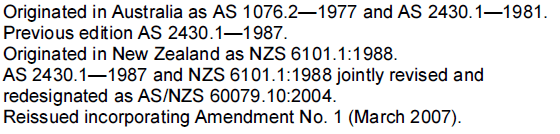
However, there are few prescriptive examples, this being something IEC standards tend to avoid, but there were good examples of documentation formats for items such as Source of Release Tables. It should be noted however, that this standard was intended to be a revision of AS 2430.1-1987 and not any part of the AS or AS/NZS 2430.3 series – as can be seen from the cover page information on this standard:
The AS and AS/NZS 2430.3 standards were still available for clarification:
“Some specific examples of area classifications are contained in the various Parts of AS/NZS 2430.3.”
AS/NZS 60079.10.1 – 2009 (+A1)
This modified version of IEC 60079.10.1 had additional Annexes added to incorporate the prescribed classification solutions from the AS/NZS 2430.3 series of standards in Annex ZA as well as other Annexes:
- Annex ZA (informative) Examples of hazardous area classification
- Annex ZB (informative) Generalized method of classification
- Annex ZC (normative) Risk assessment for EPL
Not only were the Source of Release classification methods (by example) included in Annex ZA, but examples of the Generalized Method were included in Annex ZB. The concept of EPLs (Equipment Protection Limits) were also introduced into Annex ZC.
It should be noted that all these Annexes are noted as being “informative” (for information) and not granted the status of “normative” (compulsory to consider).
Source of Release Hazardous Area Extent – By Calculation
IEC 60079.10.1 contains methodology to estimate the release rates of sources of release in Annex A4 – Examples of estimating release rate.
These equations, when used in conjunction with the ventilation calculations described in Annex B.5 Assessment of degree of ventilation and its influence on the hazardous area, can be used to back calculate the hypothetical volume (Vz) of the hazardous area, based on the Lower Explosive Limit (LEL) fraction (50% or 25% depending on the release type). This volume could then be considered as a sphere and a value for the radius of the hazardous area formed (Rz) could then be calculated.
Some things to note however:
- Both Annex A and B are “informative” and not “normative”. These are “for information” and not “mandatory”.
- While the specific gas or vapour types (including molecular densities) are considered as are the types of release types and the ventilation conditions, the assumption of the spherical form of the hazardous area of volume Vz, and hence the radius of the hazardous area Rz are assumptions that may not represent the reality of the situation.
- Heavier than air gases and vapours will have an extent to ground and a potentially smaller upward vertical extent.
- Lighter than air gases and vapours will have an extent upward from the release, to a greater extent than below the source of release.
- While a release rate can be calculated from Annex A, one must first know the size of the cross-sectional area of the release mechanism (valve packing, flange gasket, etc). Often, this is an assumption, even if based on worst case assumptions from such industry standard references as EI-15 (Model code of safe practice – Part 14 – Area classification for installations handling flammable fluids).
- Further, release rates for various products such as valves (around the valve packing) and for various gasket types, are functions of the type of seal, the pressure behind these and wear/maintenance issues. Example: Release rates for gasketed flanges can range from 1 x 10⁻⁸ kg/s for a spiral wound metal gasket to 1 x 10⁻⁴ kg/s for a standard gasket type.
- There is no long-term history of determining hazardous area extent by the calculations within this standard, to determine if the actual risk is suitably low, when compared to prescribed distances which are historically without incident when correctly applied.
- It is recommended that any calculation technique be that which uses an acceptable solution such as the PHAST program.
Annex B8 - Calculation Example No 6 – Methane Gas
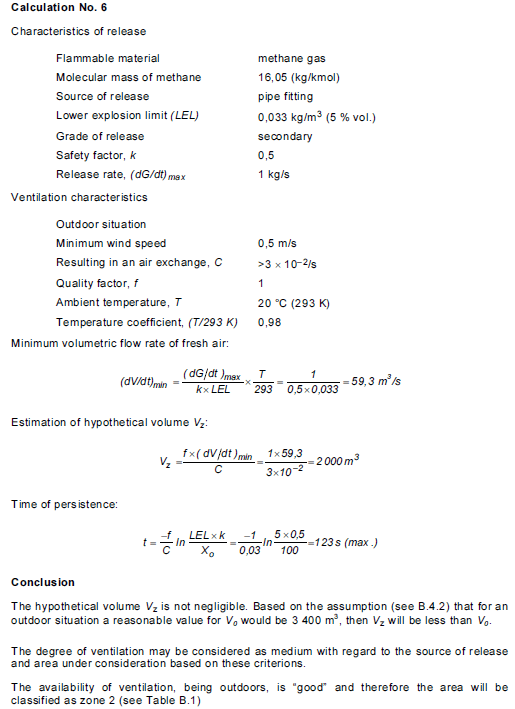
Note that Methane is a lighter than air gas, with relative density of 0.55. The upper extent of such a release would tend to be greater than the lower extent. This is even more pronounced for Hydrogen. All that can be inferred is a spherical volume from this equation and a constant radius.
While worst case estimates for the variables can be made, and values for Rz calculated, the effect of wind velocity (apart from the consideration of the minimum figure of 0.5 m/s), is largely ignored within the equation.
At best, the used of these equations to calculate hazardous area extents are, with good input data, an estimate of the hazardous area extents. Further, the value of persistence time is somewhat dubious, if the release is continuous, as would generally be the case for most Secondary and Primary sources of release.
However, from experience, even when using the most conservative of values for release rate, the linear extent of the hazardous area tends to be less than the values prescribed in the informative Annex ZA of this standard.
Annex ZA - Source of Release Hazardous Area Extent Example
Taking examples from ZA.6.4 Lighter-than-air flammable gases—Other installations only, which would include (again) Methane and Hydrogen as potential gases, and focusing on Table ZA.6.4.2.3 (2):
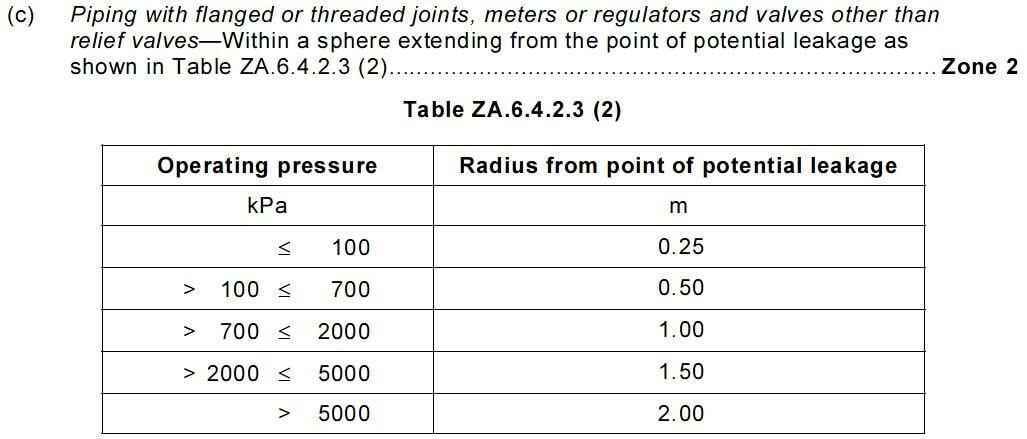
This table provides a sensible range of extents for various pressures, yet still assumes a spherical release, even though this table is in the section of the standard entitled as follows: ZA.6.4 Lighter-than-air flammable gases—Other installations.
This prescribed (yet only “informative”) suggestion for a classification does not take into account, that the gas release will tend to rise – with Methane (relative density of 0.55) and particularly with Hydrogen (relative density of 0.07). However, these prescribed solutions for hazardous zone extents have statistical validity in that there have been no incidents that can be traced back to the correct application of the Annex ZA examples.
Annex B Calculations compared to Annex ZA Solutions
As an academic exercise, the following calculation was performed using the data below using Calculation 6 methodology and Hydrogen as the release gas – making the following assumptions:
- use of a spiral wound gasket on a flange joint,
- a pressure of some 3000 kPa and
- a worst cast release rate of 1 x 10 -6 kg/s based on worst case OEM data.,
Resultant - the radius Rz calculated using Calculation 6 was 0.15 metres, as opposed to the 1.5 metres specified in the above table for any “lighter than air gas”.
With such a result, it is probable that modelling this Hydrogen system using software such as PHAST will be able to produce more exact results, potentially reduce hazardous area extents and by inference, reduce the quantity of both explosion protected equipment installations required and the number of resulting periodic inspections.
Annex ZB – Generalized Method
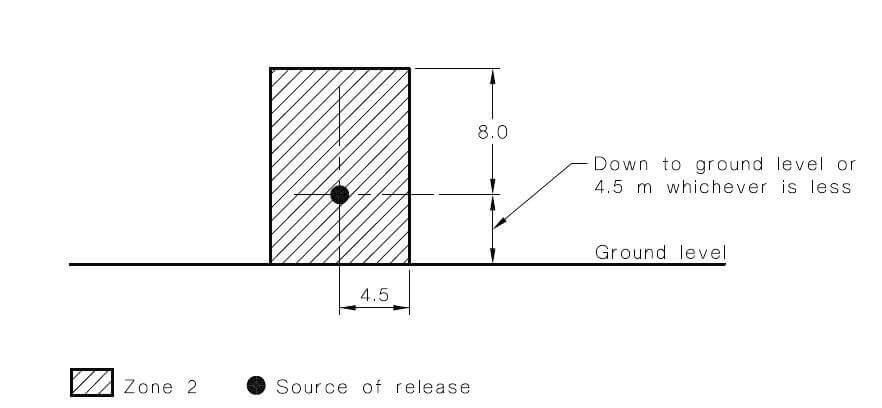
The above is Figure ZB.5 – Adequately ventilated process area—Release under abnormal conditions from Annex ZB of AS/NZS 60079.10.1. From the Zone 2 area formed, it can be assumed that the source of release is Secondary. While this is noted as an example of an abnormal release, such a philosophy can be applied to large areas of many individual sources of release and have but one classification for the entire installation site.
Note that the extents are large compared to the model in Annex ZA for say a flange joint release, at a pressure exceeding 5000 kPa. That would have an extent of 2 metres under Annex ZA Table ZA.6.4.2.3 (2), but a 4.5 metre lateral and 4.5 / 8 metre vertical extent for Annex ZB.5 - ignoring for the moment that this release is stated as an “abnormal release” (but with no further details).
Caution - It is also possible that a Zone 1 area might exist within any large Zone 2 area within the figure. With the
Generalised Area method of Annex ZB, it is possible to miss the existence of Zone 1 areas within these large Zone 2 areas.
Summary - Pros and Cons
Calculation, Annex ZA and Annex ZB Methods
The following table summarises the pros and cons of the above methods:
|
Characteristic |
Calculation |
Annex ZA |
Annex ZB |
Comment |
| Zone extents |
More precise and potentially smaller. PHAST or a similar program should be employed. |
Conservative and sometimes overly large. However, is accepted within the industry and identifies Zone
1 and Zone 2 areas distinctly. |
Large. A blanket method in some cases in which large Zone 2 areas can mask Zone 1 areas |
For both Calculation and Annex ZA methods, many sources of release in close proximity will tend to an Annex ZB like result. |
| Quantity of Explosion Protected Equipment per Installation |
Least parts count (potentially) for explosion protected equipment |
Average parts count for explosion protected equipment. |
Large parts count for explosion protected equipment. |
Less EEHA equipment required equates to lower project cost overall. |
| Numbers of EEHA Inspections Required |
Potentially the least due to less frequent need for explosion protected equipment |
An “average” number of explosion protected items. |
Potentially the most due to all equipment within a blanket Zone 2 (with Zone 1 areas potentially
included |
Less EEHA inspections equate to lower costs for initial and subsequent periodic inspections. |
| Classification Issues |
Potentially expensive and time consuming |
Medium expense and medium time frame |
Short time frame – but investigation into Zone 1 areas should be conducted as well. |
A short term gain of blanket classifying an installation will result in a potentially expensive installation with labour intensive
inspection requirements. |
This material is produced by HAZ. The information is of a general nature only and should not be relied upon. Each set of circumstances associated with compliance of hazardous areas and Type B compliance is unique and expert advice on your particular circumstances should be sought. HAZ accepts no liability for any reliance on the information published on this website.