HAC-API RP 505
Published
Read Time: 10 min
Area Classification using API RP 505 – Application to Drilling Rigs
The standard API RP 505 – Recommended Practice for Classification of Locations for Electrical Installations at Petroleum Facilities Classified as Class I, Zone 0, Zone 1, and Zone 2, is a standard commonly used in Australia for various gas and Liquid Natural Gas (LNG) installations, for the classification of hazardous areas. The philosophy of this standard is much the same as the Generalised Method, which is briefly outlined in AS/NZS 60079.10.1 Appendix ZB.
Legislation which Directly or Indirectly Refers to API RP 505
Mandatory Acts and Regulations exist which call up Australian and sometimes International Standards which may be referred to in these Acts
and Regulations as either Mandatory or Preferred. In Queensland, the following Acts and Regulations are relevant to the extraction and
processing of gases and make references to particular standards:
Petroleum and Gas (Production and Safety) Act 2004 – Section 557 “Obligation to comply with Act and prescribed standards”, where the word “Standard” is defined as “standard includes an Australian Standard, an international standard or a code or protocol.”
Electrical Safety Regulation 2013 - Section 221 “High voltage or hazardous area electrical installation not to be connected to electricity source without inspection”.
The Electrical Safety Regulation further requires compliance with AS/NZS 3000 “Wiring Rules”, which states in Section 7.7 “Hazardous Areas” wherein AS/NZS 3000 Clause 7.7.2 “Classification of Hazardous Areas”, subsection 7.7.2.1, “Responsibility for Classification” states as follows:
“The responsibility for classification of a hazardous area (see Clause 1.4.15) rests with the persons or parties in control of the installation. The requirements are contained in AS/NZS 60079.10.1 for gas or vapour and AS/NZS 60079.10.2 for combustible dust.”
AS/NZS 60079.10.1, Section 2 “Normative References”, refers to:
RP 505, Recommended Practice for ‘Classification of Locations for Electrical Installations at Petroleum Facilities classified as Class I, Zone 0, Zone 1 and Zone 2’ API (American Petroleum Institute)
AS/NZS 60079.10.1 provides no particular guidance nor examples on how a gas drilling rig should be classified. The following examples
from API RP 505 are generally used when classifying such an installation. Refer to Section 10 of API RP 505:
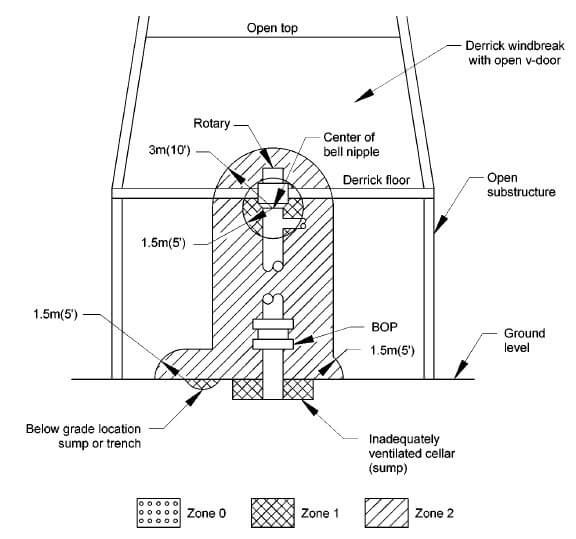
Figure 29 above is the classification for a mobile drilling rig, set up and in operation, and with adequate ventilation. This is the usual configuration and classification for such a rig.
Expected Groups and Temperature Classifications
While the predominant flammable is Methane (CH4) which is a Group IIA and Temperature Classification T1 gas, small amounts of Hydrogen Sulphide (H2S) can occur, entrained in the Methane.
While it is extremely unlikely that any concentration of Hydrogen Sulphide could ever reach the Lower Explosive Limit of 4 % or 40,000 ppm (the gas is instantly lethal at 500 ppm), such sites are often conservatively classified as Group IIB and Temperature Classification T3, to cover Hydrogen Sulphide as well.
Expected Hazardous Area Zones
Zone 2
Referring to Figure 29 of API RP 505, the predominant classification is Zone 2, with a maximum extent from the equipment of 3 metres.
Zone 1
Again, referring to Figure 29 of API RP 505, Zone 1 areas exist around the centre of the Bell Nipple (extent 1.5 metre radius) and in any sump or trench.
Conclusions
API RP 505 is a Normative reference within AS/NZS 60079.10.1 and, when appropriate, must be considered when plant and equipment is undergoing a hazardous area classification.
AS/NZS 60079.10.1 does not contain any specific examples in either Appendix ZA (source of release) or Appendix ZB (generalised method) which describe the potential sources of release for a gas drilling rig, or describe the potential Zone types and extents which such an equipment would generate in normal operation.
AS API RP 505 solutions following the Generalised Method, and are comparatively easy to apply, are conservative and hence provide less risk than using, say, a source of release by calculation method.
This material is produced by HAZ. The information is of a general nature only and should not be relied upon. Each set of circumstances associated with compliance of hazardous areas and Type B compliance is unique and expert advice on your particular circumstances should be sought. HAZ accepts no liability for any reliance on the information published on this website.