Dust Aint Gases
Published
Read Time: 5 mins
General
Both Flammable Gases & Vapours and Combustible Dusts are ignition hazards and can form hazardous areas. See below:
|
Frequency of Hazard |
Flammable Gas & Vapour Zone |
Combustible Dust Zone |
| Constantly Hazardous |
Zone 0 |
Zone 20 |
| Sometimes Hazardous |
Zone 1 |
Zone 21 |
|
Rarely Hazardous |
Zone 2 |
Zone 22 |
Flammable gas of vapour will always form a hazardous zone of one type or another, governed by type of substance, pressure and type or source of release.
Combustible dust will only form a hazardous zone if it is airborne. That is, it forms a cloud. Combustible dust layers do not form a hazardous zone but can be sources of release if disturbed. There is also a Dust Layer ignition hazard to be considered.
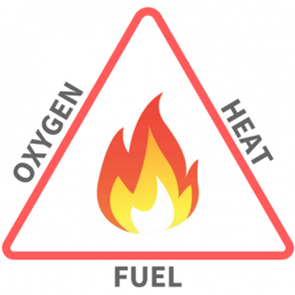
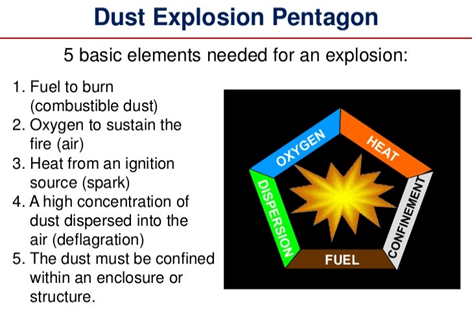
Ignition Triangle Vs Dust Explosion Pentagon
 |
 |
Flammable Gases and Vapours
The Ignition Triangle above depicts the three requirements for the ignition of a flammable gas or flammable vapour. This would also include flammable mists from high pressure leakage from a small orifice for flammable and some combustible liquids – known as a Mist.
Combustible Dusts
The Dust Explosion Pentagram above depicts the same criteria as those required for ignition of flammable gases and vapours, but also includes the additional criteria of Dispersion and Confinement. Unlike flammable gases and vapours which only require Fuel, Oxygen and an Ignition Source, Combustible Dust requires two extra criteria in order to cause a conflagration – Dispersion and Confinement.
Dispersion: Combustible Dust requires to be Dispersed in Air in order to react with air. A range of particle sizes is also required. The larger particles agitate the smaller particles, preventing “clumping” that would occur with a uniformly fine dust.
Confinement: In order for a pressure build up to occur that will turn a conflagration of burning particles into an explosion, the mixture must be confined in a comparatively small space. This ensures two things:
- The combustible dust is above its lower explosive limit of “x” g/m3, and
- Pressure will build up until some aspect of the containment vessel fails mechanically.
Means to Mitigate these Hazards
Flammable Gases and Vapours:
Protection Techniques for flammable gases and vapours include the following:
- Flameproof enclosures “d”
- Oil filled enclosures “o”
- Intrinsic safety “i”
- Pressurized enclosures “p”
- Increased safety “e”
- Sand filled enclosures “q”
- Protection by Enclosure “t” (used to be DIP or tD)
- Encapsulation “m”
- Non-sparking (Non-incendive/restricted breathing) “n”
- Optical radiation “op”
- Non-electrical “h”
- Special protection “s”
Adequate ventilation is also a prerequisite to minimise the type and extent of hazardous zones. Surface temperatures are also an important characteristic of these techniques.
Combustible Dusts
Protection techniques are for combustible dusts or are also suitable for combustible dusts:
- Ex ‘t’ (formerly Ex tD and before that DIP)
- Ex i (formerly Ex iD)
- Ex m (formerly Ex mD)
- Ex p (formerly Ex pD)
Surface temperature ratings are marked on all combustible dust certified equipment. The only reduction means of hazardous zones available is to not produce them in the first place, by ensuring all seals are in good condition on enclosures and equipment processing the product, and capture of the combustible dust by vacuum extraction.
Ventilation is a negative factor with combustible dusts, as this will simply further disperse a combustible dust cloud, as well as disturbing any combustible dust layers (which then become sources of release) which then adds to the fuel load and the size of the hazardous area formed.
Mitigation of Hazardous Gas/Vapour and Dust Clouds
The best form of mitigation (reduction or removal) of these is to not allow these to occur in the first place. This can be achieved or at least lessened by correct design and effective and frequent maintenance.
Gas/Vapour Mitigations
The following techniques are effective in the mitigation of flammable gas and vapour hazards:
- Ventilation – this dilutes the flammable gas or vapour to the point where it is significantly below (25% of) the Lower Explosion Limit
- Containment of the vapours and gases within process vessels and piping.
- For heavier than air vapours, the used of vapour barriers can be effective – preventing the vapours from moving towards uncertified equipment
- Natural barriers are also a credible means – such as walls, rooves, topography.
Combustible Dust Mitigations
The following techniques are effective in the mitigation of combustible dusts:
- Stone dusting in coal mines, which places a layer of inert material over exposed coal faces.
- Vacuum extraction (using antistatic hose) to remove the dust as it is produced
- Physical barriers, such as walls or rooves are also effective
- Dust curtains can limit the extent of the hazardous areas.
- Effective and constant cleaning (housekeeping)
Summary
Flammable Gases and Vapours and Combustible Dusts are very different creatures. What may work for one – might work for another – or may make it worse.
This material is produced by HAZ. The information is of a general nature only and should not be relied upon. Each set of
circumstances associated with compliance of hazardous
areas and Type
B compliance
is unique and expert advice on your particular circumstances should be sought. HAZ accepts no liability for any reliance on the
information published on this website.