Hydrogen - An Electrical Perspective
Published
Read Time: 2 mins
Hydrogen - An Electrical Perspective
Hydrogen is the lightest element with an atomic number of 1. It is a colorless, odourless, lighter than air, readily ignitable, flammable gas.
The information in the table below was sourced from AS/NZS 60079.20.1:2012 “Explosive atmospheres - Material characteristics for gas and vapour classification - Test methods and data”.
| CAS No. |
Name Formula |
Relative Density |
Melting Point (°C) |
Boiling Point(°C) |
Flash Point (°C) |
LFL (Vol %) |
UFL (Vol %) |
Auto Ignition Temp (°C) |
Temp Class |
Equipment Group |
| 1333-74-0 |
Hydrogen (H) |
0.07 |
-259.2 |
-252.9 |
Gas |
4.0 |
77.0 |
560 |
T1 |
IIC |
A few key specific characteristics that should be pointed out are:
- Hydrogen has a relative density of 0.07 (with respect to air), which explains its incredible buoyancy.
- Hydrogen has a boiling point of -252.9°C, which means that it takes a lot of energy to liquefy Hydrogen.
- Because of its very low boiling point, a liquid release of hydrogen will tend to rapidly vaporize and may not reach the ground in liquid form. Any loss of Hydrogen will quickly dissipate into the atmosphere.
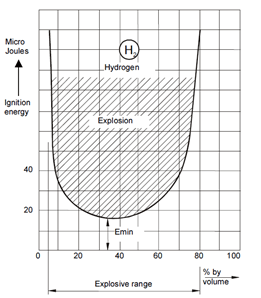
- To ignite a flammable mixture of Hydrogen in air, only 19 μJ (micro Joules). This is the energy produced because of a break of 0.1 mS duration in a circuit carrying 20 mA in 10 V.
- The large flammability range of Hydrogen (4 % - 77 % volume percent) is shown graphically below:
When Hydrogen is produced or used in an operating plant, certain requirements must be met to ensure that electrically the installation is going to be safe. These requirements are stated in AS/NZS 3000 Section 7.7 - Classification of hazardous areas. The following is stated:
The responsibility for classification of a hazardous area rests with the persons or parties in control of the installation. The requirements are contained in AS/NZS 60079.10.1 for gas or vapour.
In addition to this in Queensland there is a legal requirement under the Electrical Safety Regulation Section 221, that a hazardous area accredited auditor inspect and confirms the plant and equipment before it is energised.
As more projects are underway with the introduction of Hydrogen as a fuel which will eventually displace Natural Gas (e.g., Hydrogen Fueling Stations, cars and transports using Fuel Cell Technology, Hydrogen Storage) an education program regarding Hydrogen Safety becomes more urgent as time goes on.
Spend the time to ensure that you have met your responsibility and obligations when considering Hydrogen projects and when specifying electrical equipment ensure that it has the correct certification and is fit for purpose as Hydrogen is highly flammable and only takes a small amount of energy to ignite.
This material is produced by HAZ. The information is of a general nature only and should not be relied upon. Each set of
circumstances associated with compliance of hazardous
areas and Type
B compliance
is unique and expert advice on your particular circumstances should be sought. HAZ accepts no liability for any reliance on the
information published on this website.