What is Adequate and Inadequate Ventilation?
The Quality of the Ventilation at a site can dictate the types and extents of any hazardous areas that may be formed. When we discuss the Quality of Ventilation, we are referring to a site which has Adequate Ventilation. This may be either Natural or Artificial in nature. Otherwise, we are dealing with an Inadequately Ventilated site.
Note: This paper is based on AS/NZS 60079.10.1 :2009 (+A1). This standard is based on IEC 60079.10.1:2008. The superseding standard, IEC 60079.10.1:2015 embraces a number of changes in concept and description and was not referred to in this paper. A comparison of AS/NZS 60079.10.1:2009 (+A1) and IEC 60079.10.1:2015, will be the subject of a separate paper.
Ventilation
To specify that plant or equipment is located in ‘open air’ or in some ‘sheltered area’ does not clearly define the ventilation condition to determine whether there is ‘adequate’ or ‘inadequate’ ventilation to promote the dispersion of any hazardous gas or vapour, or that artificial ‘dilution ventilation’ is required (refer also to AS/NZS 60079.13:2019 for the requirements of a Ventilated, or Ex v system).
Adequate Vs Inadequate
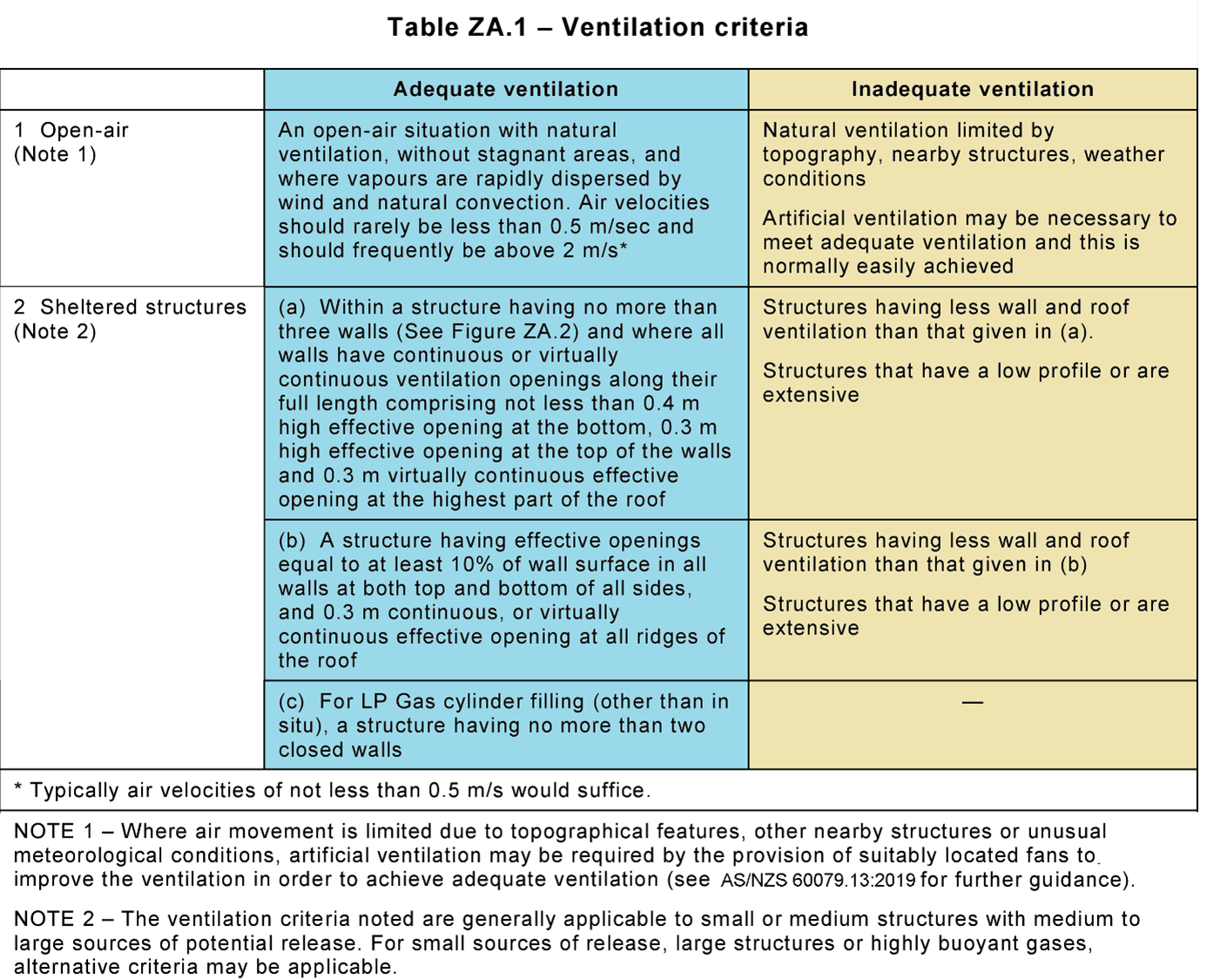
AS/NZS 60079.10.1, Table ZA.1 defines the criteria for both Adequate and Inadequate Ventilation:
Ventilation degree and availability
Degree of Ventilation
The effectiveness of the ventilation in controlling dispersion and persistence of the explosive gas atmosphere will depend upon the degree and availability of ventilation and the design of the system. For example, ventilation may not be sufficient to prevent the formation of an explosive gas atmosphere but may be sufficient to avoid its persistence.
The following three degrees of ventilation are recognized:
High Ventilation
Can reduce the concentration at the source of release virtually instantaneously, resulting in a concentration below the lower explosive limit. A zone of negligible extent results. However, where the availability of ventilation is not good, another type of zone may surround the zone of negligible extent.
Medium Ventilation
Can control the concentration, resulting in a stable zone boundary, whilst the release is in progress, and where the explosive gas atmosphere does not persist unduly after the release has stopped. The extent and type of zone are limited to the design parameters of the installation.
Low Ventilation
Cannot control the concentration whilst release is in progress and/or cannot prevent undue persistence of a flammable atmosphere after release has stopped.
Availability of Ventilation
The availability of ventilation has an influence on the presence or formation of an explosive gas atmosphere and thus also on the type of zone. Thus the availability (as well as the degree) of ventilation needs to be taken into consideration when determining the type of zone.
Three levels of availability of the ventilation should be considered:
Availability = Good: ventilation is present virtually continuously;
Availability = Fair: ventilation is expected to be present during normal operation. Discontinuities are permitted provided they occur infrequently and for short periods;
Availability = Poor: ventilation which does not meet the standard of fair or good, but discontinuities are not expected to occur for long periods.
Ventilation that does not even meet the requirement for poor availability must not be considered to contribute to the ventilation of the area.
The Influence of Ventilation on the Type of Zone
With reference to AS/NZS 60079.10.1, The effect of ventilation on the type of the zones can be summarized in a modified version of Table B.1.
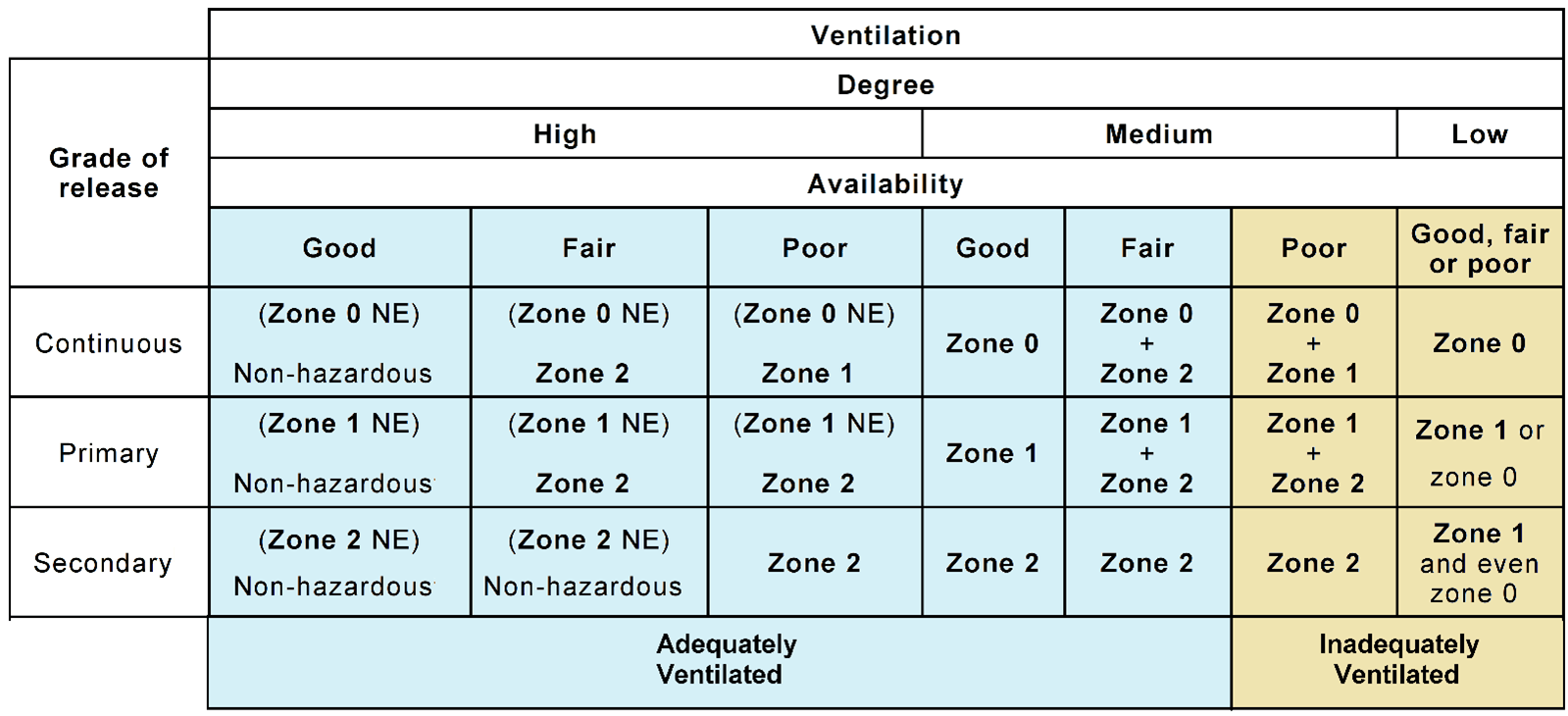
Those combinations of Ventilation Degree and Availability that may lead to Adequate and Inadequate Ventilation have been highlighted in the above modified Table B.1 above.
Natural and Artificial Ventilation
Natural ventilation
For outdoor areas, the evaluation of ventilation needs to consider the local minimum wind speed and availability. If the minimum wind speed is ≥ 0.5 m/s and will be present virtually continuously, the availability of the ventilation can be considered as good.
Artificial ventilation
In assessing the availability of artificial ventilation, the reliability of the equipment and the availability of, for example, standby blowers should be considered. Good availability will normally require, on failure, automatic start-up of standby blower(s). However, if provision is made for preventing the release of flammable material when the ventilation has failed (for example, by automatically closing down the process), the classification determined with the ventilation operating need not be modified, i.e. the availability may be assumed to be good.
This material is produced by HAZ. The information is of a general nature only and should not be relied upon. Each set of
circumstances associated with compliance of hazardous
areas and Type
B compliance
is unique and expert advice on your particular circumstances should be sought. HAZ accepts no liability for any reliance on the
information published on this website.