Fitness for Purpose Study – Component Certified Ex d Enclosure
Published
Read Time:
AS/NZS 60079.17:2017 Annex C provides guidance on conducting a Fitness for Purpose Assessment. This is an “informative” Annex and is not necessarily mandatory. However, using this guidance will provide an assessment of compliance with no “holes” in it.
A fitness for purpose report should:
- Be undertaken where an enclosure has only Component Certification and was subsequently fitted out.
- Demonstrate the equipment is “fit for its purpose” and “safe to use”, with conditions of use as required.
- Be a form of risk assessment which demonstrates an equivalent level of safety to a similar product which has been certified, considering all potential eventualities. Some examples are:
- Surface Temperature and Temperature Classification (all techniques)
- Pressure piling if an Ex d enclosure
- The use of other certified apparatus in conjunction with the parent equipment, as an entire assembly
- Creepage and Clearance distances maintained (Ex e and Ex n)
- Certification of components used in the complete assembly – conformity assessments as required for the individual components.
- Demonstrate compliance to AS/NZS standards.
- Consider any likely ignition sources and their probable frequency.
- Define the purpose and use of the equipment, including the hazardous area in which it is to operate and relevant environmental conditions.
- Limit the use of the equipment to a particular site or usage for one entity.
Compliance to AS/NZS standards including installation and inspection standards, must be demonstrated. In order for a Fitness for Purpose report to “hang together”, it needs to have evidence for all claims, or acceptable calculations or analysis for any statements or assumptions made.
Case of Ex d Component Certified Enclosure
Example:
Scenario:
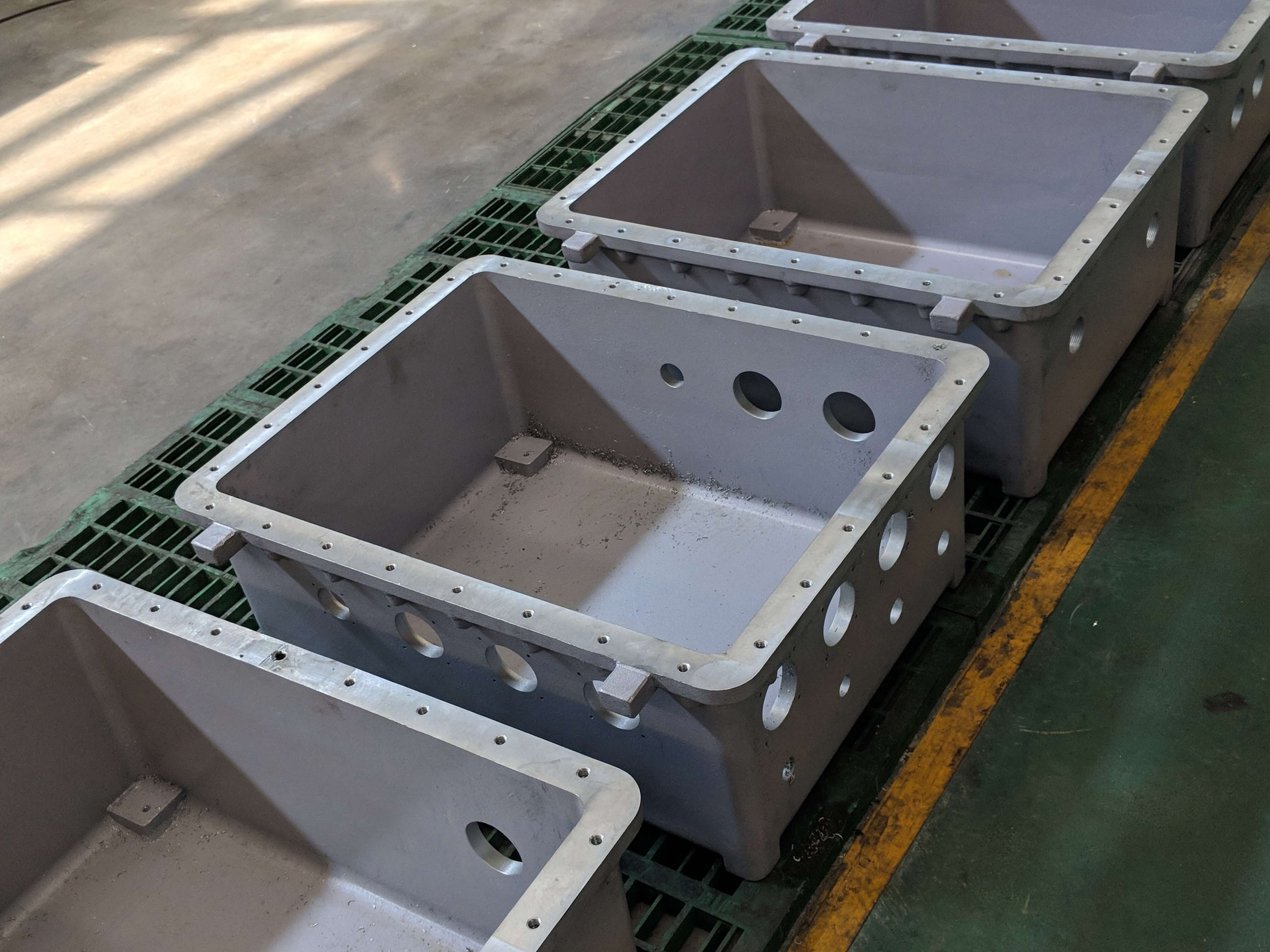
An Ex d enclosure (basically a 30 cm cube of cast light alloy construction with a bolted cover) which has component IECEx certification (certified as an empty enclosure). The enclosure is Group IIB and has an Ingress Protection (IP) Rating of IP66. Note the lack of a Temperature Classification for the enclosure.
This has a single Zener Barrier installed within it which is also IECEx certified. The Zener Barrier is associated apparatus which must be installed in a non-hazardous area and has Ex ia outputs.
All cable entries are via compression glands which are also IECEx certified. These glands are certified as Group IIB and IP66/67.
While the site maximum ambient temperature from the Bureau of Meteorology is less than 40C, the effect of insolation (heating due to direct solar radiation) should be considered.
Assessment:
- Initial: The Zener Barrier will dissipate only a few watts. The enclosure has a mass of some 15 kg, measures 30 x 30 x 30 cm and is 25 mm thick and is made of a cast light alloy.
- Assume that the enclosure is in direct sunlight (in the Pilbara are, W.A.) and that insolation (the absorbing of solar heat) will give rise to a 60°C surface temperature – which can be taken as the Ambient Temperature in this instance, with no internal power dissipations considered.
- Refer to the Zener Barrier certification and use the following calculation – Pmax = 2 x Uo x Io (2 times for maximum power transfer). Assume Uo = 28V and Io = 100 mA. Pmax is then calculated to be 5.6 W.
- Calculations based on the enclosure geometry can be made (available from many on-line resources or enclosure handbooks) to determine what power dissipation will achieve what surface temperature rise.
- Confirm compliance to T6 requirements as follows:
- Assuming T6 compliance for the moment, this is limited to an 85°C surface temperature in a 40°C ambient. That is – a 40°C Temperature Rise. Note that 40°C is the reference temperature at which all temperature classifications are defined – an assumption allowed unless another ambient temperature has been specified under certification.
- Using a 5°C factor of safety, assume an 80°C maximum surface temperature for a 40°C ambient temperature.
- This is a 40°C temperature rise over the 40°C ambient temperature. However, as the actual assumed worst case ambient temperature is 60°C, the maximum temperature rise that is allowable (with the 5°C factor of safety is 60°C - 40°C = 20°C.
- Calculate the power dissipation required for a 20°C temperature rise in a 60°C ambient temperature for this enclosure geometry. Calculated elsewhere – this is approximately 160W maximum for T6. See https://www.oemheaters.com/topic/enclosure-heating - one of many resources on line.
- It has been calculated that the maximum internal power dissipation cannot exceed 5.6W by limitations of the Zener Barrier design.
- Therefore, with only the Zener Barrier installed, a Temperature Classification of T6 can be awarded for a 60°C ambient temperature.
- Consider other aspects of the design, such as the likelihood of Pressure Piling within the enclosure (in this case, with a sole Zener Barrier installed – and not crammed with other components – this would be unlikely).
- Also confirm that the IP ratings of all the components (glands) are no less than that of the enclosure.
- Allocate a marking code for the enclosure (considering it has no temperature classification marked on it and considering this now has an intrinsically safe output). In this case Ex d [ia] IIB T6 IP66 (Tamb ≤ 60°C).
- Affix a label to the enclosure modelled on the example from the standard:

- Compile the report based on recommendations on AS/NZS 60079.17 Annex C.
- Make the statement at the end of the report that the enclosure with the Zener barrier installed (quote model numbers and certificate numbers) is considered to be “Fit for Purpose” as currently configured and that any changes to the contents of the enclosure will nullify this assessment, and will require reassessment.
This material is produced by HAZ. The information is of a general nature only and should not be relied upon. Each set of
circumstances associated with compliance of hazardous
areas and Type
B compliance
is unique and expert advice on your particular circumstances should be sought. HAZ accepts no liability for any reliance on the
information published on this website.