Amibent Temperature & Temperature Class
Published
Read Time: 5 Mins
Ambient Temperature
Definition – Ambient Temperature (AS/NZS 60079.0:2012 Clause 3.1):
“The temperature of the air or other media, in the immediate vicinity of the equipment or component.
NOTE: This does not
refer to the temperature of any process media, unless the equipment or component is totally immersed in the process media. See 5.1.1.”
AS/NZS 60079.0:2012 Section 1 – Scope, makes a number of statements which relate to the certification of equipment for use in hazardous areas. While Paragraph 2 states the assumed Ambient Conditions:
“The standard atmospheric conditions (relating to the explosion characteristics of the atmosphere) under which it may be assumed that electrical equipment can be operated are:
- temperature –20°C to +60°C (but see Note 1)
- pressure 80 kPa (0.8 bar) to 110 kPa (1.1 bar); and
- air with normal oxygen content, typically 21 % v/v”
Note 1 states:
“NOTE :1 Although the standard atmospheric conditions above give a temperature range for the atmosphere of - 20°C to +60°C, the normal ambient temperature range for the equipment is –20°C to +40°C, unless otherwise specified and marked. See 5.1.1. It is considered that –20°C to +40°C is appropriate for most equipment and that to manufacture all equipment to be suitable for a standard atmosphere upper ambient temperature of +60°C would place unnecessary design constraints.”
Therefore, it can be assumed that any certified hazardous area equipment which has no ambient temperature range marked on it or stated within the certificate of conformity, has an inherent ambient temperature range of –20°C to +40°C only.
This is commonly the case for most IECEx or ATEX certified items, as this reflects a worst-case scenario for the United Kingdom and Europe. However, ambient temperatures in Australia (particularly in remote, inland areas) can reach up to +55°C and represents a shift from the assumed/certified maximum ambient temperature of Tambient actual – 40 = ΔT.
Temperature Classifications
The following temperature classifications are allocated at the time of Certification and are referenced to a maximum Ambient Temperature of +40°C.
| Temperature Classification |
Maximum Surface Temperature (°C) |
Ignition Temperature Range (°C) |
| T1 |
450 |
> 450 |
| T2 |
300 |
> 300 and ≤ 450 |
| T3 |
200 |
> 200 and ≤ 300 |
| T4 |
135 |
> 135 and ≤ 200 |
| T5 |
100 |
> 100 and ≤ 135 |
| T6 |
85 |
> 85 and ≤ 100 |
Table 1 - The temperature limits
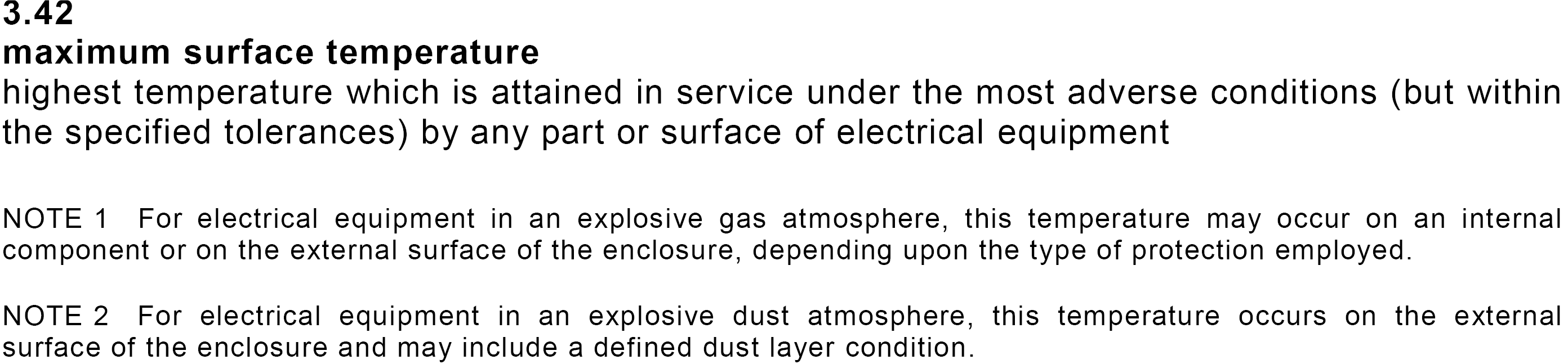
These Temperature Classifications relate to the Maximum Surface Temperature as defined below in AS/NZS 60079.0 Clause 3.4.2, determined experimentally at the time of the original assessment, testing and certification:
How Temperature Rise Testing is Conducted
At the time of original testing at an Ex Testing Laboratory, Temperature Rise testing is conducted at the local ambient temperature, for example 23°C. Generally, equipment is not tested at 40°C in an Environment Chamber, for example.
At the same time as the temperature rise testing is conducted (with thermocouples or other temperature sensors) on several surfaces of the Equipment Under Test, the local ambient temperature is monitored using at least two thermocouples. Ambient temperature will change throughout the day, but this is measured at the same place that the Temperature Rise testing is being conducted and on the same multichannel recording instrument.
Once the Temperature Rise of the Equipment Under Test stabilises to within ± 2°C, the test can be concluded. The worst case (least) Ambient Temperature is then subtracted from the worst case (hottest) temperature measurement, to determine the Worst-Case Temperature Rise. From Section 1.2 of this paper, the following equation was introduced:
T worst case temperature - Tleast ambient temperature = ΔT K
(“ΔT” for difference in temperatures and “K” for Kelvin – as this is not a static temperature but a difference in temperature)
Example 1:
Problem: The final, worst case temperature was recorded on top of the enclosure, and is +130°C.
The least ambient temperature recorded at the time that the worst-case temperature was recorded was +31°C.
Normalise this temperature rise to +40°C and hence determine the Temperature Classification.
Solution 1:
Determine the Temperature Rise. ΔT = 130 – 31 = 99K.
Note the desired, reference Ambient Temperature. Tamb ref = +40°C.
Add the Tamb ref to ΔT and determine the Temperature Rise referenced to Tamb ref:
Temperature Rise = 40 + 99 = 139°C.
From Table 1 - The temperature limits for T4 > 135°C and ≤ 200°C. Therefore, the equipment may be certified with a Temperature Classification of T4 with respect to a 40°C Ambient Temperature.
Adjusting the Temperature Classification for a Hotter Ambient Temperature
Example 2:
Background: The equipment from Example 1 is certified for a maximum ambient temperature of 40°C, but the Site Specification requires that all equipment be suitable/certified for a maximum ambient temperature of 55°C.
Problem: Determine the resulting new Temperature Classification if this equipment were to be used in a location with a +55°C ambient temperature.
Solution 2:
Determine the New Temperature Rise.
ΔT = “Original Temperature Rise” – 40°C +55°C. = 139 -40 + 55 = 154°C
The new maximum surface temperature is therefore 154°C
From Table 1, 154°C falls between > 135°C and ≤ 200°C, which are the temperature limits for T4
Conclusion:
The equipment, now to be used in a +55°C ambient temperature, still complies with a temperature classification of T4.
This material is produced by HAZ. The information is of a general nature only and should not be relied upon. Each set of
circumstances associated with compliance of hazardous
areas and Type
B compliance
is unique and expert advice on your particular circumstances should be sought. HAZ accepts no liability for any reliance on the
information published on this website.