What can be a CAD and what cannot
Published
Read Time: 5 mins
Conformity Assessment Documents – CADs
Conformity Assessment Documents are basically a risk analysis of and equipment design which was certified to a scheme that was not IECEx or ANZEx. For these to be successful with ATEX certification, the originally certified standards must align to current or at least recent standards for those aspects of these local standards which apply to the equipment under examination. For pre ATEX standards, this is often not possible. Later generation North American standards have good parallels between flameproof and explosion proof, but comparisons to other techniques have to be considered on a case by case basis. Note: Not all conformity assessments yield positive results. Unless these are conducted to IEC aligned standards, there are no guarantees.
ATEX Certifications
EN 60079 Series of Standards
Recent ATEX Certifications to the CENELEC EN 60079 series of standards (or the BS EN Series for the UK) are said to be “harmonised” to IEC standards. The methodology when compiling a CAD is to determine the root IEC standard that aligns with the EN 60079 series standard, and then find the AS/NZS standard that was based on the same IEC standard version. Such certifications to EN 60079 series of standards are good candidates for conformity assessments.
EN 50 000 Series of Standards
The superseded EN 50 000 series of standards are obsolete, do not align particularly well with the requirements of any current EN 60079 standards, and are generally found on equipment which has been in service for over twenty years.
It may be possible to establish conformity with current IEC based standards for the following with restrictions to the following protection techniques form the old EN 50 000 series of standards – some examples:
- Ex d – IIA & IIB equipment has good alignment with IEC. IIC requirements have poor alignment with IEC
- Ex e – Some testing requirements vary. Clearance and Creepage distances are the same.
- Ex q – same concept
- Ex o – same concept
It is not possible to establish conformity to IEC based standards for the following techniques:
- Ex m – very different to IEC requirements. Different tests and chemicals used to check potting.
- Ex n – the requirements for this technique have changed, and there is poor alignment with IEC.
- Ex N (older version of Ex n concept) – no real parallels to IEC version of Ex n
- Ex i – many changes to this concept after the last edition of EN 50020. Poor alignment with IEC.
- Ex p – many changes to this concept
- Ex t – many changes to this concept
EN 50 000 Series Standard |
IEC 60079 Series Standard |
Comments |
|
EN 50014 General Requirements (last issued in 1998) |
IEC 60079.0 General Requirements (current issue 2012) |
Good parallels with basic testing and requirements for documentation and marking. |
| EN 50015 Oil immersion Ex o (last issued in 1998) |
IEC 60079.6 Oil immersion Ex o (last issued 2015) |
Similar concept |
|
EN 50016 Pressurised Ex p (last issued in 2002) |
IEC 60079.2 Pressurisation Ex p (last issued 2014) |
Many differences |
|
EN 50017 Sand filling Ex q (last issued in 1998) |
IEC 60079.5 Sand filling Ex q (last issued 2015) |
Similar concept |
|
EN 50018 Flameproof Ex d (last issued in 2000) |
IEC 60079.1 Flameproof Ex d (last issued 2014) |
Good parallels with IIA and IIB testing and dimensional requirements, but not aligned to current IIC testing. Suggest only using this as a
Group IIA only standard. |
| EN 50019Increased Safety Ex e (last issued in 2000) |
IEC 60079.7 Increased safety Ex e (last issued 2015) |
Basic clearance and creepage data is identical, but some testing not aligned to current IEC methods. |
| EN 50020 Intrinsic Safety Ex i (last issued in 2002) |
IEC 60079.11 Intrinsic Safety Ex i (last issued 2011) |
Many differences |
|
EN 50021 Non-sparking Ex n (last issued in 1999) |
IEC 60079.15 Non-sparking Ex n (last issued 2017) |
Many differences |
| EN 50028 Encapsulation Ex m (last issued in 1987) |
IEC 60079.18 Encapsulation Ex m (last issued 2014) |
Many differences |
| EN 50281-1-1 Protection by enclosure (last issued in 1998) |
IEC 60079.31 Dust Exclusion Ex t (last issued 2013) |
Many differences |
North American STANDARDS
Certifications to Underwriters Limited (UL), Factory Mutual (FM) and Canadian Standards Association (CSA) are commonplace for equipment used in mining, oil and gas and are often imported as new or old equipment and sold to persons who wish to use them in Australia.
The issue is that these are not only certified to schemes not recognised by Australian states and territories, the standards to which these are certified are often very different to the IEC standards that the AS/NZS standards are based on.
CADs may be developed for some of the North American techniques successfully, but only on a case by case, machine by machine basis. There are no guarantees that a CAD can be successfully produced to North American standards.
However, HAZ has a successfully conducted comparisons between the more common North American standards and various versions of our IEC based
standards.
Its all in the Documentation
For all equipment, certified under any scheme and to any standards, certain documentation must be made available by the client.
While HAZ generally undertakes to source the correct standards, attempting to get data and certificates from the original manufacturer or the local sales agent can take a long time, and may provide negative results, particularly for older equipment where the records are not on-line.
The documents that must be presented, as a bear minimum, are as follows:
- What hazardous zone is this equipment to be installed in – e.g. – Zone 1 Group IIA, T1
- Are the certification marking labels/equipment nameplates still present? If not – no assessment is possible.
- Are the certification marking labels/equipment nameplates legible? If not – no assessment is possible.
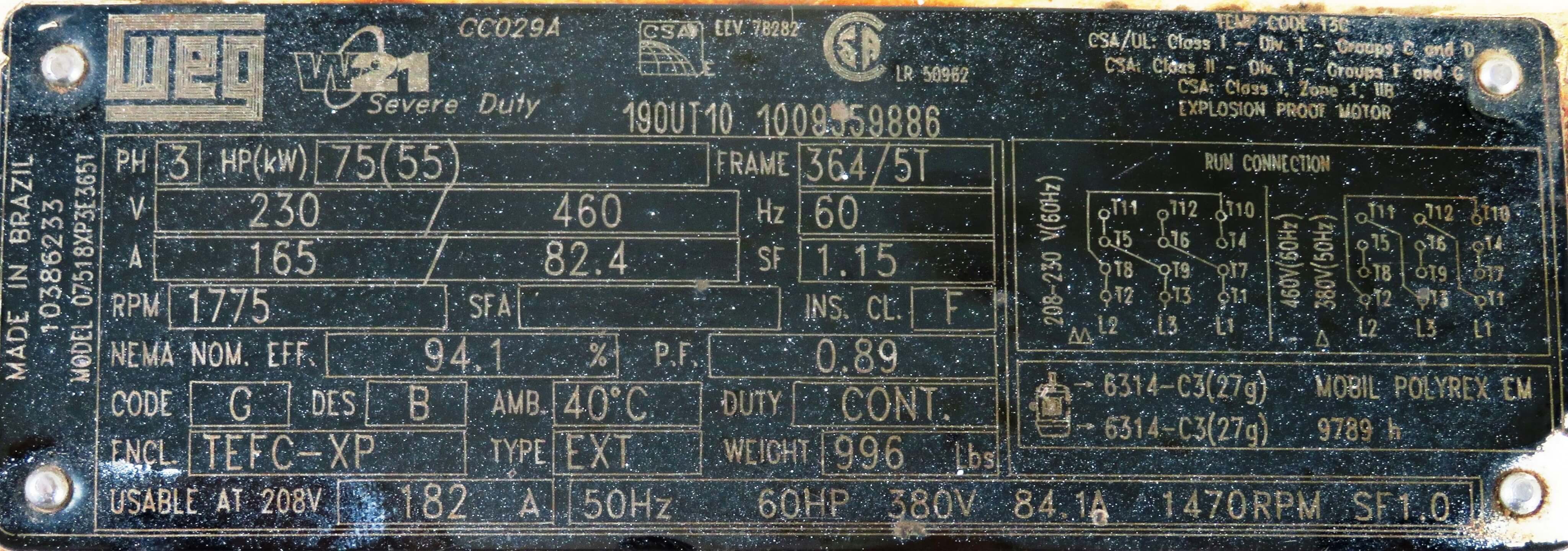
- Assuming the certification marking labels/equipment nameplates are in reasonable condition, high resolution photographs of these labels are required, in lieu of an actual site inspection. The minutest detail on these labels must be discernible.
- An overall picture of the equipment
- Datasheets and manuals for the equipment
- Certificates of Conformity or Certificates of Compliance, as marked on the equipment labels are required. The Certification Summaries from CSA and UL are not well received by regulators – even though they do, in the opinion of HAZ, provide the correct degree of traceability.
- If the certificate number is not marked on the equipment label, this will cause difficulties. This means that HAZ will have to do a data search on the equipment and contact the original manufacturer for details and copies of the relevant certification.
Summary
The question is - at the end of the day, is it worth the cost and time to have a Conformity Assessment Document raised in order to stave off a non-compliance from an audit, for equipment that could be twenty or thirty years old?
For single instances of one equipment type, it may be more economical to replace the unit with an IECEx or ANZEx certified equivalent.
If there are multiple instances of the same equipment with the same certification, then a conformity assessment may be the most economical solution. However, HAZ generally recommends that once any equipment covered by one of our conformity assessments fails in service, that it be replaced with a complying IECEx or ANZEx Equivalent.
This material is produced by HAZ. The information is of a general nature only and should not be relied upon. Each set of
circumstances associated with compliance of hazardous
areas and Type
B compliance
is unique and expert advice on your particular circumstances should be sought. HAZ accepts no liability for any reliance on the
information published on this website.