IP Ratings - What do they mean?
Published
Read Time: 5 mins
What are Ingress Protection (IP) Ratings?
These ratings are defined by AS 60529:2004 (R2018) (IEC 60529 Ed 2.1:2001) “Degrees of Protection Provided by Enclosures (IP Code)”. The older standard, AS 1939, was superseded by AS 60529 in 2004.
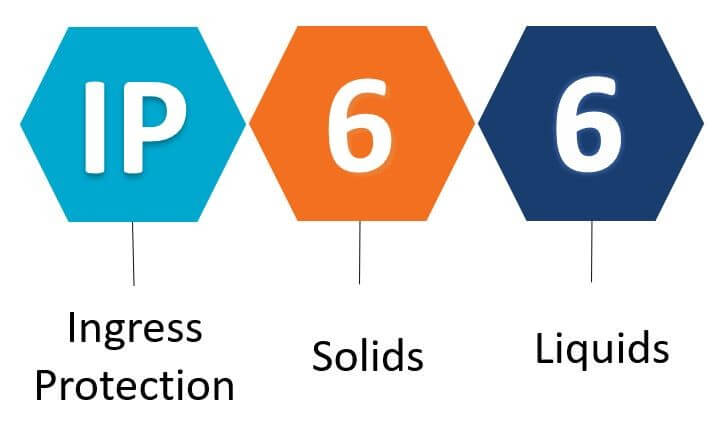
IP ratings are Ingress Protection ratings. This is what the initials “IP” stand for. There is no such a thing as “international protection” ratings (but this is heard out there on site). The IP Code describes the ability of an enclosure to resist entry of objects, dust and moisture, for various specific conditions. It should be noted that an enclosure with an IP rating is NOT explosion protected of itself, but that some techniques – such as Ex n and Ex e enclosures - require at least an IP54 rating for their overall compliance.
What does an IP Rating do for an enclosure?
An enclosure, certified by testing to AS 60529, has proven measures to protect both the enclosure and the enclosed equipment from the following:
- Against the ingress of foreign objects (including fingers) (first numerals 0 through 4)
- Against the ingress of dusts (first numerals 5 and 6)
- Against the ingress of moisture (second numerals 0 through 8)
There are additional and supplementary letters that can be assigned, but this level of understanding is covered in a more detailed paper on the subject.
First Numeral – Foreign Objects and Dust
| First Characteristic Numeral |
Degree of Protection |
Test Conditions - See AS 60529 Clause: |
|
| Brief Description | Definition | ||
| 0 | Not protected | - | - |
| 1 | Protected against access to hazardous parts with the back of a hand. | The access probe, sphere of 50 mm ∅, shall have adequate clearance from hazardous parts and shall not fully penetrate. | 12.2; 13.2 |
| 2 | Protected against access to hazardous parts with a finger. | The jointed test finger of 12mm ∅, 80 mm length, shall have adequate clearance form hazardous parts and . The object probe, sphere of 12,5 mm ∅, shall not fully penetrate |
12.2; 13.2 |
| 3 | Protected against access to hazardous parts with a tool. | The access probe of 2,5 mm ∅ shall not penetrate at all. | 12.2; 13.2 |
| 4 | Protected against access to hazardous parts with a wire | The access probe of 1,0 mm ∅ shall not penetrate at all. | 12.2; 13.2 |
| 5 | Protected against access to hazardous parts with a wire, and Dust Protected. | The access probe of 1,0 mm ∅ shall not penetrate and minor of ingress of dust is permitted provided that it will not interfere with the satisfactory operation of the enclosed apparatus. | 12.2, 13.4, 13.5 |
| 6 | Protected against access to hazardous parts with a wire and Dust Tight. |
The access probe of 1,0 mm ∅ shall not penetrate and there shall be no ingress of dust. |
12.2. 13.4, 13.6 |
Second Numeral – Water Ingress
| Second Characterictic Numeral |
Degree of Protection |
Test Conditions - See AS 60529 Clause: |
||
| Brief Description |
Definition |
|||
| 0 | Not protected | - | - | |
| 1 | Protected against vertically falling water drops | Vertically falling drops shall have no harmful effects. | 14.2.1 | |
| 2 | Protected against vertically falling water drops when enclosure tilted up to 15° | Vertically falling drops shall have no harmful effects when the enclosure is tilted at any angle up to 15” on either side of the vertical | 14.2.2 | |
| 3 | Protected against spraying water | Water sprayed at an angle up to 60° on either side of the vertical shall have no harmful effects | 14.2.3 | |
| 4 | Protected against splashing water | Water splashed against the enclosure from any direction shall have no harmful effects | 14.2.4 | |
| 5 | Protected against water jets | Water projected in jets against the enclosure from any direction shall have no harmful effects | 14.2.5 | |
| 6 |
|
Water projected in powerful jets against the enclosure from any direction shall have no harmful effects | 14.2.6 | |
| 7 | Protected against the effects of temporary immersion in water (Note: Static Pressure only – no forceful jet of water) | Ingress of water in quantities causing harmful effects shall not be possible when the enclosure is temporarily immersed in water under standardized conditions of pressure and time | 14.2.7 | |
| 8 | Protected against the effects of continuous immersion in water (Note: Static Pressure only – no forceful jet of water) | Ingress of water in quantities causing harmful effects shall not be possible when the enclosure is continuously immersed in water under conditions which shall be agreed between manufacturer and user but which are more severe than for numeral 7 | 14.2.8 | |
First Characteristic Numeral
IP67 or IP68 NOT being Greater than IP66
It should be noted in the above table that the second numeral 7 and 8 tests are for Static Pressure only, whereas the second numeral 6 tests are with a powerful jet of water, not unlike a building fire hose.
Probably because IP67 or IP68 is “numerically superior” to IP66, it has been assumed by many people in industry, that IP67 or IP68 are superior Ingress Protection ratings than IP66. Unfortunately, this is not the case.
AS 60529 has predicted this confusion and makes the following comment in Section 6 “Degrees of protection against ingress of water indicated by the second characteristic numeral” in Paragraphs 6 and 7:
“Up to and including second characteristic numeral 6, the designation implies compliance also with the requirements for all lower characteristic numerals. However, the tests establishing compliance with any one of the lower degrees of protection need not necessarily be carried out provided that these tests obviously would be met if applied.
An enclosure designated with second characteristic numeral 7 or 8 only is considered unsuitable for exposure to water jets (designated by second characteristic numeral 5 or 6) and need not comply with requirements for numeral 5 or 6 unless it is dual coded as follows:”
| Enclosure passes test for | Designation and marking | Range of application | |
| Water jets second characteristics numeral | Temporary/continuous immersion second characteristic numeral | ||
| 5 | 7 | IPX5/IPX7 | Versatile |
| 6 | 7 | IPX6/IPX7 | Versatile |
| 5 | 8 | IPX5/IPX8 | Versatile |
| 6 | 8 | IPX6/IPX8 | Versatile |
| - | 7 | IPX7 | Restricted |
| - | 8 | IPX8 | Restricted |
Ordering Enclosures or Components with an Ingress Protection Rating
When ordering components such as cable glands, always ensure that the equipment being ordered meets at least the same IP rating requirements as the parent equipment (that is, the enclosure).
An IP 66 enclosure will require IP66 cable glands. IP67/68 certified cable glands are not suitable unless it can be established that these are also compliant to IP66. Proof is required from the manufacturer in terms of a test report or a statement on their letterhead which refers to successful testing to IP66 as well as the claimed IP67/68 ratings.
IP67 Test Conditions
Also note, that IP67 is tested for a very specific set of conditions.
14.2.7 Test for second characteristic numeral 7: temporary immersion between 0.15m and 1m
The test is made by completely immersing the enclosure in water in its service position as specified by the manufacturer so that the
following conditions are satisfied:
a) the lowest point of enclosures with a height less than 850mm is located 1000mm below the surface of the water;
b) the highest point of enclosures with a height equal to or greater than 850mm is located 150mm below the surface of the water;
c) the duration of the test is 30min;
d) the water temperature does not differ from that of the equipment by more than 5K. However, a modified requirement may be specified in
the relevant product standard if the tests are to be made when the equipment is energized and/or its parts in motion.
Due to the nature of marking on small components, this is not stated.
IP68 Test Conditions
These are loosely defined in the standard as follows:
14.2.8 Test for second characteristic numeral 8: continuous immersion subject to agreement
Unless there is a relevant product standard, the test conditions are subject to agreement between manufacturer and user, but they shall be more severe than those prescribed in 14.2.7 and they shall take account of the condition that the enclosure will be continuously immersed in actual use.
IP68 – What is Not Stated
There is a danger here in that the IP68 test conditions are agreed between the manufacturer and user, as to the depth and time of immersion, and almost certainly will not be marked on the product, particularly if it is small. The manufacturer or their agent must be contacted to determine what the actual test conditions were.
The following data is required:
- Depth of Immersion and where on the equipment this depth was measured from
- Duration of Immersion
The above data should be available on a test report which the manufacturer should have in their records.
Summary
- Ingress Protection (IP) Ratings are a measure of the ability of an enclosure or component to withstand the ingress of foreign objects, dust and moisture.
- Not all IP tests are of the same type. IP67 and IP68 on their own do NOT afford better protection than IP66, as IP67 and IP68 provide protection against water ingress for a STATIC pressure, whereas IP66 provides protection against water ingress from POWER JETS of water (e.g., something similar to a fire hose).
- In order to not fall into this trap, ensure the equipment or component is dual certified as say “IP66/67” or “IP66/68”.
- Another trap to be aware of – IP68 must be defined in terms of the depth and time of immersion. To state compliance to IP68 is meaningless unless the depth and duration of immersion is also stated.
This material is produced by HAZ. The information is of a general nature only and should not be relied upon. Each set of
circumstances associated with compliance of hazardous
areas and Type
B compliance
is unique and expert advice on your particular circumstances should be sought. HAZ accepts no liability for any reliance on the
information published on this website.