IECEx Certificates Of Conformity Choosing The Correct Issue
Published
Read Time: 10 min
Certificates of Conformity can often have many issues since the original certificate. The reasons for these additional issues can be (but not limited to) any of the following:
- Change of Manufacturer or additional Manufacturer address
- Compliance to later standards for various models (perhaps not all)
- Additions to the range of certified models (which might include other conditions of safe use)
The latest certificate may not contain all the currently certified models, and if only certain items have been added to the range in the latest certificate, it is probable that the conditions of safe use, and other data/requirements from the original issue (or other issues) will also need to be referred to.
Note 1: It cannot be assumed that the latest certificate issue contains all the information for the entire certified range. This is a frequent mistake made by inspectors and end users of hazardous area product.
Note 2: The manufacturer never marks the certificate issue on their product – just the certification number. The manufacturing date may be of use, however, in determining which standards apply to the product by matching this to the certificate issue date.
IECEx Certificate Data Base
IECEx certificates of conformity and issues can easily be found at the following website:
http://iecex.iec.ch/iecex/exs.nsf/ex_eq.xsp?v=e
- Ensure you check the original certificate (issue 0) for any Conditions of Certification or Conditions of Safe Use
- Also check the original certificate Annex, where the tabulated parameters for various models within the certified range is often located. Often this is a separate document to the actual certificate and are found by clicking on a link above
IECEx KEM 06.0034U – ISSUE 0
Simply type “KEM 06.0034”: into the “Certificate/ExTR/QAR number” input field and click on SEARCH.
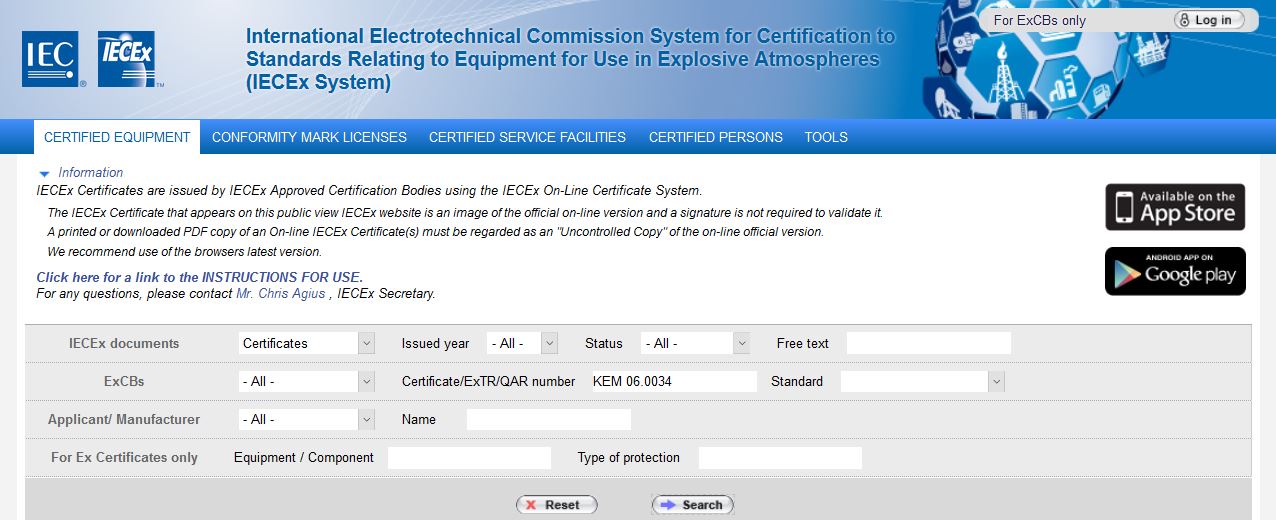
The following will result (only issue 0 shown here):

On the last page of issue 0 of this certificate, the following link to the relevant Annexes for the certificate can be found:
Annexes: IECEx KEM 06.0034U.pdf
The models certified by this certificate are:
- UK 1.5N
- UK 2.5N
- UK 3N
- UK 5N
- UK 6N
Compliance to the following standards is certified:
IEC 60079-0 : 2004 (Edition: 4) Electrical apparatus for explosive gas atmospheres - Part 0: General requirements
IEC 60079-7 : 2001 (Edition: 3) Electrical apparatus for explosive gas atmospheres - Part 7: Increased safety 'e'
IECEx KEM 06.0034U – ISSUE 6
Now, download Issue 6 of this certificate as well as it’s Annex (Annex 1):

The following models certified in Issue 6 are as follows:
- UK 1.5N
- UK 3N
- UK 5N
- UK 6N
Note: Model UK 2.5N has been withdrawn from the range.
Compliance to the following standards is certified:
IEC 60079-0 : 2017 (Edition: 7.0) Explosive atmospheres - Part 0: Equipment - General requirements
IEC 60079-7 : 2017 (Edition: 5.1) Explosive atmospheres - Part 7: Equipment protection by increased safety "e"
WHAT DOES IT MEAN?
Things to be learnt from this:
The originally certified UK 2.5N terminal listed in Issue 0 of the certificate (and also in Issues 1, 2, 3 and 4) is still certified if already found installed on site, provided that the purchase date is no later than the date noted on the last certificate Annex that lists this model. As no manufacturing date is generally stamped on site small components, in this case, the purchase date is the only one that can be relied on. However, this can also be confirmed with the Manufacturer or his agent.
The last issue of this certificate, Issue 6, does not contain the UK 2.5N model. This may seem misleading at first, as the certificate number will still be stamped on the terminal. However, as stated earlier, issue numbers are never stamped on IECEx certified equipment.
CONCLUSIONS
- Always check all certificate issues to ensure that your product is listed on them and has not been either superseded or no longer certified
- Instances do occur where models in the range on the last certificate do not cover all models certified
- When in doubt, always get written confirmation from the Manufacturer or his agent, after providing them with all the information, including photographs of the certificate number on the device, and a profile view of the device itself
This material is produced by HAZ. The information is of a general nature only and should not be relied upon. Each set of
circumstances associated with compliance of hazardous
areas and Type
B compliance
is unique and expert advice on your particular circumstances should be sought. HAZ accepts no liability for any reliance on the
information published on this website.