Hydrogen Sulphide H2S Explosive Limits
Published
Read Time: 5 mins
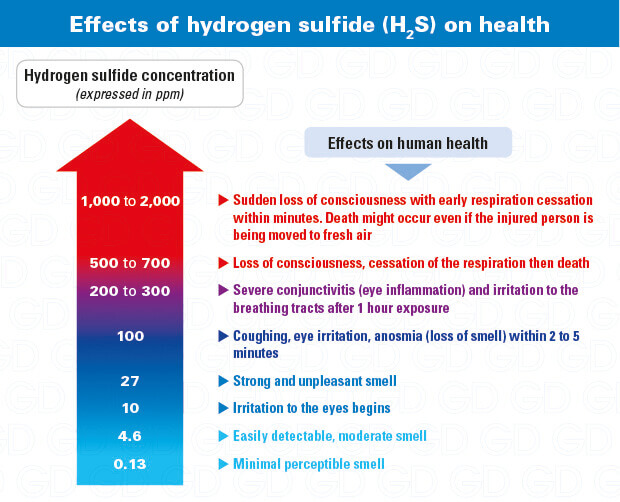
To first understand H2S it is wise to know the toxic levels and as a guide the following should be reviewed if working in the presence of H2S .
To relate that to the workplace Safe Work Australia requirements, “Workplace Exposure Standards For Airborne Contaminants (date 27/4/2018)
states the following:

The definition of TWA and STEL are as follows:
- 8-hour Time-Weighted Average (TWA) means the maximum average airborne concentration of a substance when calculated over an eight-hour working day, for a five-day working week.
- The Short Term Exposure Limit (STEL) means the time-weighted average maximum airborne concentration of a substance calculated over a 15 minute period.
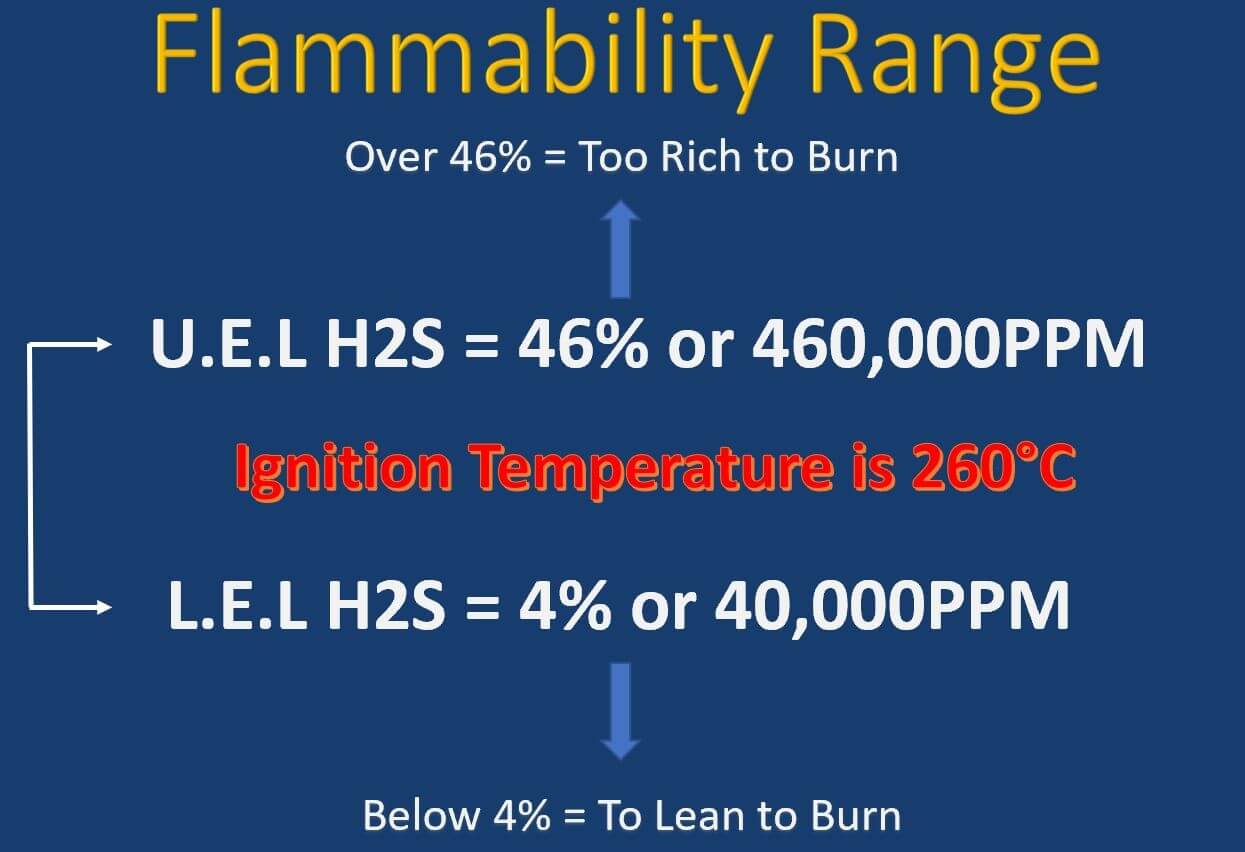
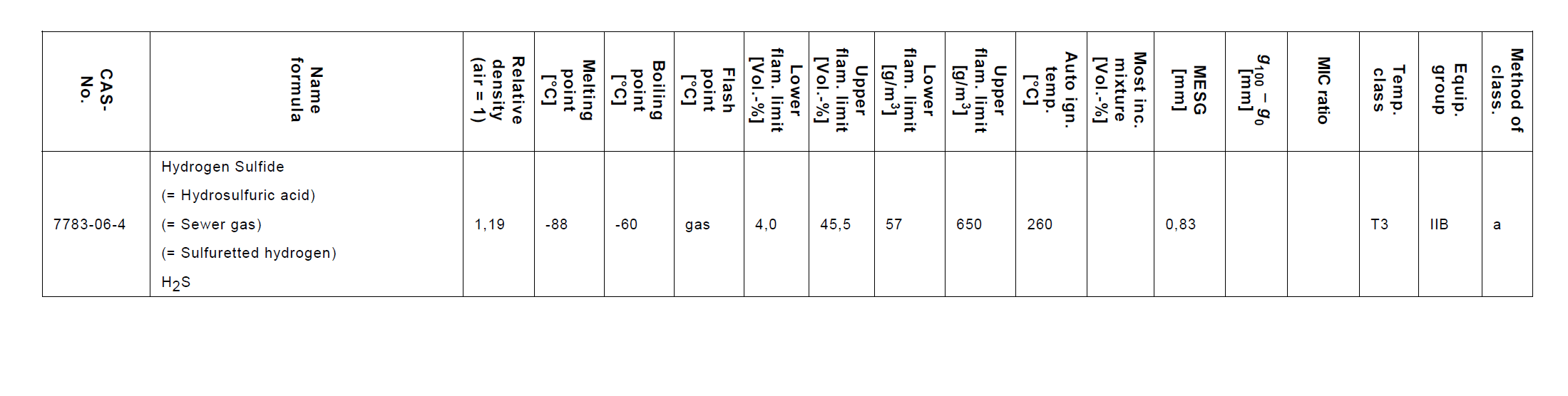
From AS/NZS 60079.20.1 it can be seen that H2S has a Lower Explosive Limit (LEL) of 4% (40,000 ppm) in air and an Upper Explosive Limit (UEL) of 46% (460,000 ppm) – orders of magnitude above the acutely toxic concentration.
 Therefore,
at concentrations between 4 and 46% an explosive hazard exists. The autoignition temperature for H2S is 260°C (T3), its Group is
IIB.
Therefore,
at concentrations between 4 and 46% an explosive hazard exists. The autoignition temperature for H2S is 260°C (T3), its Group is
IIB.
Practically, this is rarely above 20 to 40 ppm in any coal seam or other natural Methane source and in biogas, which is found depending on the feed material composition to the digester could range between as low as about 50–10,000 ppm. Although this is never present in Flammable concentrations from natural methane sources – but can be present in Toxic concentrations. Portable 4 gas detectors read H2S in ppm, not percent. They detect Toxic levels, which are many orders of magnitude lower than the Lower Explosion Limit. They do not detect explosive levels of H2S.
For an explosion to occur three basic conditions have to be met.
- A fuel or flammable material must be present within the flammable range (≥ LEL and ≤ UEL).
- An oxidising material that can react with fuel must also be present (e.g., oxygen present in air), and
- An ignition source (e.g., hot surface, sparking, flame) must be present.
Below the LEL, the concentration of the Hydrogen Sulphide in the mixture is not at a sufficient concentration to support an explosion. Its lethal concentration is of the order of 500 ppm (0.05% in air). Conversely above the UEL the concentration of the fuel is too rich and there is insufficient oxidant present (oxygen in air) to react with the fuel and produce an explosion.
Natural gas is usually considered sour if there are more than 5.7 milligrams of H2S per cubic meter of natural gas, which is equivalent to approximately 4 ppm (0.0004% in air) by volume in standard temperature and pressure conditions. However, this threshold varies by country, state, or even agency or application.
This material is produced by HAZ. The information is of a general nature only and should not be relied upon. Each set of
circumstances associated with compliance of hazardous
areas and Type
B compliance
is unique and expert advice on your particular circumstances should be sought. HAZ accepts no liability for any reliance on the
information published on this website.