Flammable Gas / Vapour - The Essentials
Published
Read Time: 5 mins
Basic Considerations
The ignition and sustained combustion of flammable gases and vapour actually requires more than the basic three – Air, Fuel and Ignition Source. Some critical concerns are:
- Lower Explosion Limit (LEL)[1] and Upper Explosion Limit (UEL)[2]
- Auto-Ignition Temperatures and Temperature Classifications
- Minimum Ignition Energy (MIE)
- Limiting Oxygen Concentration (LOC)
- Critical Parameters
- Mists
Note:-
[1] LEL (Lower Explosion Limit) may be used interchangeably with the term LFL (Lower Flammable
Limit)
[2]
UEL (Upper Explosion Limit) may be used interchangeably with the term UFL (Upper Flammable Limit)
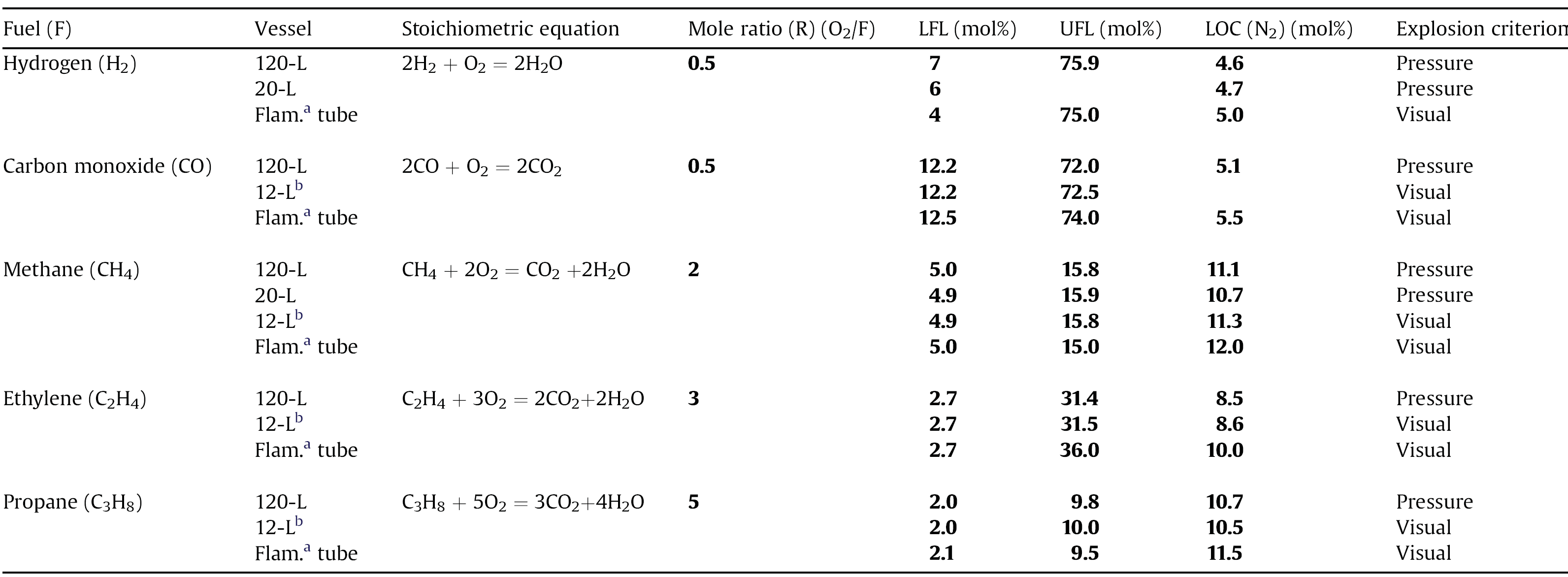
LEL and UEL
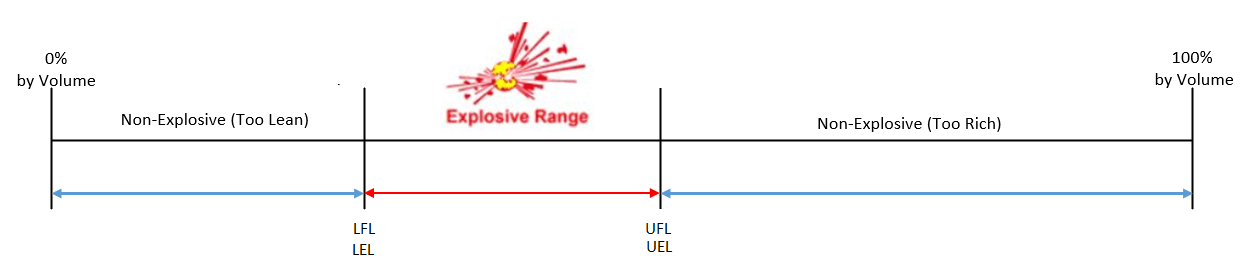
The LEL and the UEL are critical parameters of any flammable gas or vapour. Combustion cannot proceed if the mixture is “too lean” (below the LEL) or “too rich” (above the UEL).
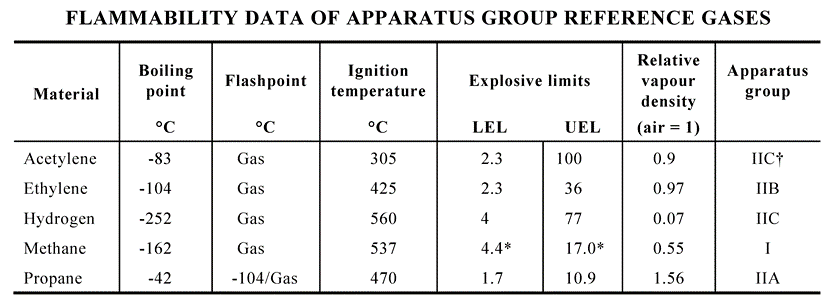
Examples of gases used when testing Flameproof and other techniques are listed below:
Auto-Ignition Temperatures and Temperature Classifications
Also referred to as the Ignition Temperature. Each flammable Gas or Vapour will have its own specific Auto-Ignition Temperature or “AIT”. AS/NZS 60079.0:2012 Clause 3.37 defines the Ignition Temperature as follows:
“The ignition temperature of an explosive gas atmosphere is the lowest temperature of a heated surface which, under specified conditions according to IEC 60079-20-1, will ignite a flammable substance in the form of a gas or vapour mixture with air”
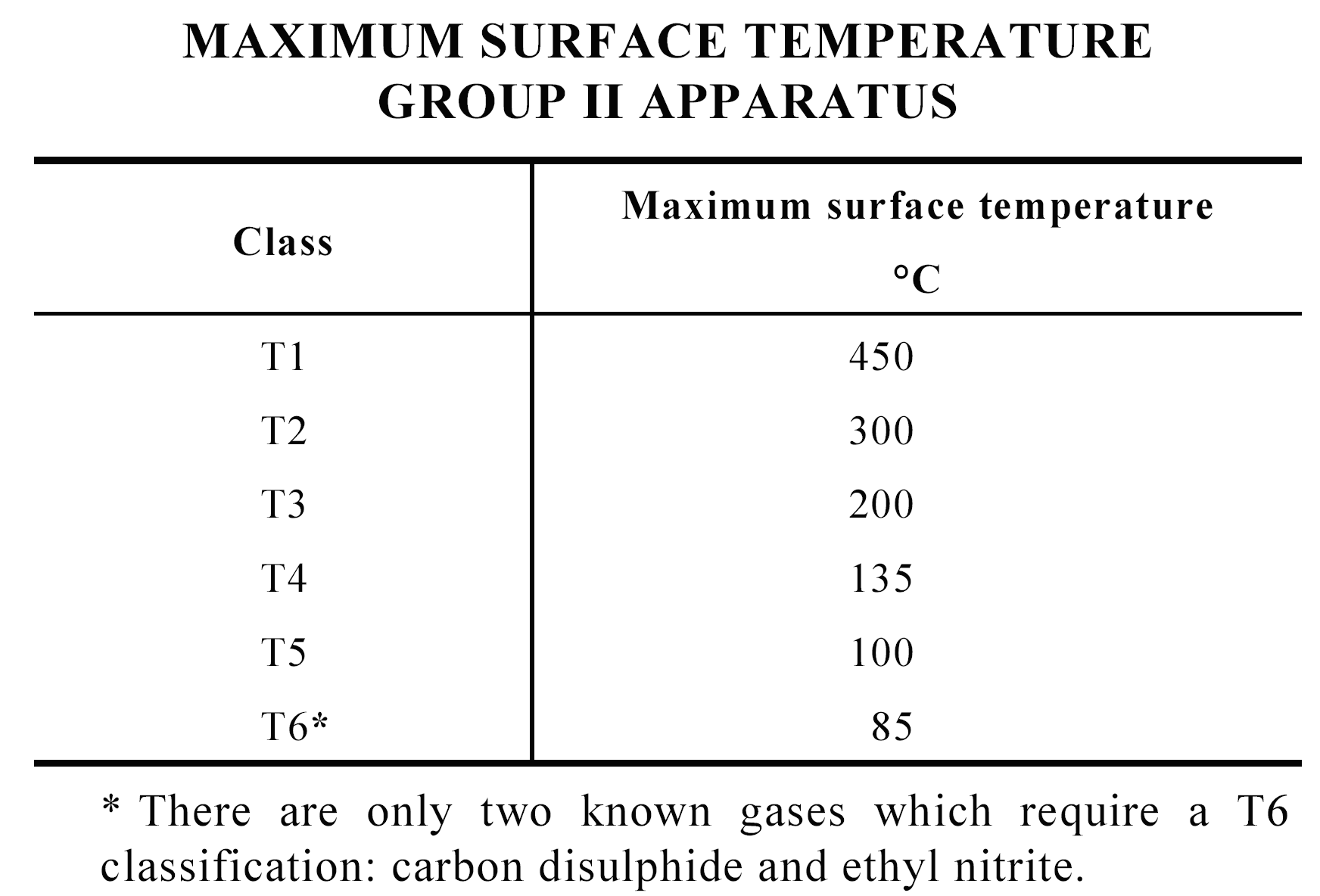
Refer to table above for examples. In order to more easily design and certify equipment for hazardous area applications, the concept of Temperature Classification was created, which (for IEC and AS/NZS) is separated into six separate ranges of Ignition Temperatures/Maximum Surface Temperatures:
Examples:
From the table above ( Flammability Data of Apparatus Group Reference Gases), the following gases/vapours have these Ignition Temperatures and corresponding Temperature Classifications:
|
Gas or Vapour |
Ignition Temperature (°C) |
Temperature Range (°C) |
Temperature Classification |
| Acetylene |
305 |
>300; < 450 |
T2 |
| Ethylene |
425 |
>300; < 450 |
T2 |
| Hydrogen |
560 |
>450 |
T1 |
| Methane |
537 |
>450 |
T1 |
| Propane |
470 |
>450 |
T1 |
Minimum Ignition Energy
The Minimum Ignition Energy is that energy required to ignite a particular gas or vapour, in air. For gases and vapours, this ranges from 19µJ (micro joules) to over 300µJ. The Table below provides examples of ignition energies for some gases and vapours:
|
Gas/Vapour |
Ignition Energy (µJ) |
| Acetylene |
19 |
| Hydrogen |
20 |
| Methane |
290 |
| Propane |
260 |
| Unleaded Petrol |
240 |
Limiting Oxygen Concentration
The Limiting Oxygen Concentration is the minimum level of Oxygen required to support combustion in the presence of an ignition source and a flammable gas or vapour. This principle is used in LNG (Liquid Natural Gas) tanks where it is impossible to have zero air within them, even with Nitrogen blanketing, but it is possible to severely limit oxygen concentrations (generally to 5% or less as LNG – mainly liquified Methane - has a LOC of 10.7%). Refer to the Figure below.
Critical Parameters
A number of parameters have a significant effect on the flammability of a liquid. Critical parameters are:
- Vapour Pressure
- Flash Point
- Vapour Density
- LEL and UEL
- Ignition Temperature
|
Flammable Liquid |
Vapour Pressure @ 20°C (kPa) |
Flash Point (°C) |
Vapour Density (c.f. Air) |
LEL (% Vol.) |
UEL (% Vol.) |
Ignition Temp. (°C) |
| Diesel No. 1 |
0.27 |
38 - 72 |
4.06 |
0.7 |
5.0 |
210 |
| Diesel No. 2 |
0.1 |
52 - 96 |
> 3.0 |
0.6 |
6.5 |
254 - 285 |
| Kerosene |
0.06 |
38 - 72 |
4.06 |
1.0 |
6.0 |
210 - 228 |
| Unleaded Petrol |
30 - 90 |
-46 |
3.0 |
1.4 |
7.6 |
280 |
| Ethanol |
5.9 |
12 |
1.59 |
3.1 |
19 |
400 |
| Acetone |
24.1 |
-20 |
2.0 |
2.5 |
14.3 |
539 |
| Carbon Disulphide |
47.9 |
-30 |
2.64 |
0.6 |
60 |
90 |
| Diethyl Ether |
58.7 |
-45 |
2.55 |
1.7 |
39.2 |
175 |
| Flammability Increases With: |
Increase in Vapour Pressure |
Decrease in Flash Point |
Increase in Vapour Density |
Decrease in LEL |
Increase in UEL |
Decrease in Ign. Temp. |
| Flammability Decreases With: |
Decrease in Vapour Pressure |
Increase in Flash Point |
Decrease in Vapour Density |
Increase in LEL |
Decrease in UEL |
Increase in Ign. Temp. |
Note: Flammability always increases with increased Oxygen content (or another oxidizer).
For a Liquid to be classed as Flammable, the Flash Point must be ≤ 61°C.
Mists
For a Mist to form, the requirements are High Pressure and Small Exit Orifice (Visualise a Spray Pack). Mists are flammable, even from Combustible liquids. To quote AS/NZS 60079.10.1 Clause 5.4.1 (d):
“An explosive gas atmosphere cannot exist if the flashpoint is above the relevant maximum temperature of the flammable liquid. The lower the flashpoint, the greater may be the extent of the zone. However, if a flammable material is released in a way that forms a mist (for example, by spraying) an explosive atmosphere may be formed below the flashpoint of the material.”
This material is produced by HAZ. The information is of a general nature only and should not be relied upon. Each set of circumstances associated with compliance of hazardous areas and Type B compliance is unique and expert advice on your particular circumstances should be sought. HAZ accepts no liability for any reliance on the information published on this website.