Temperature Classes
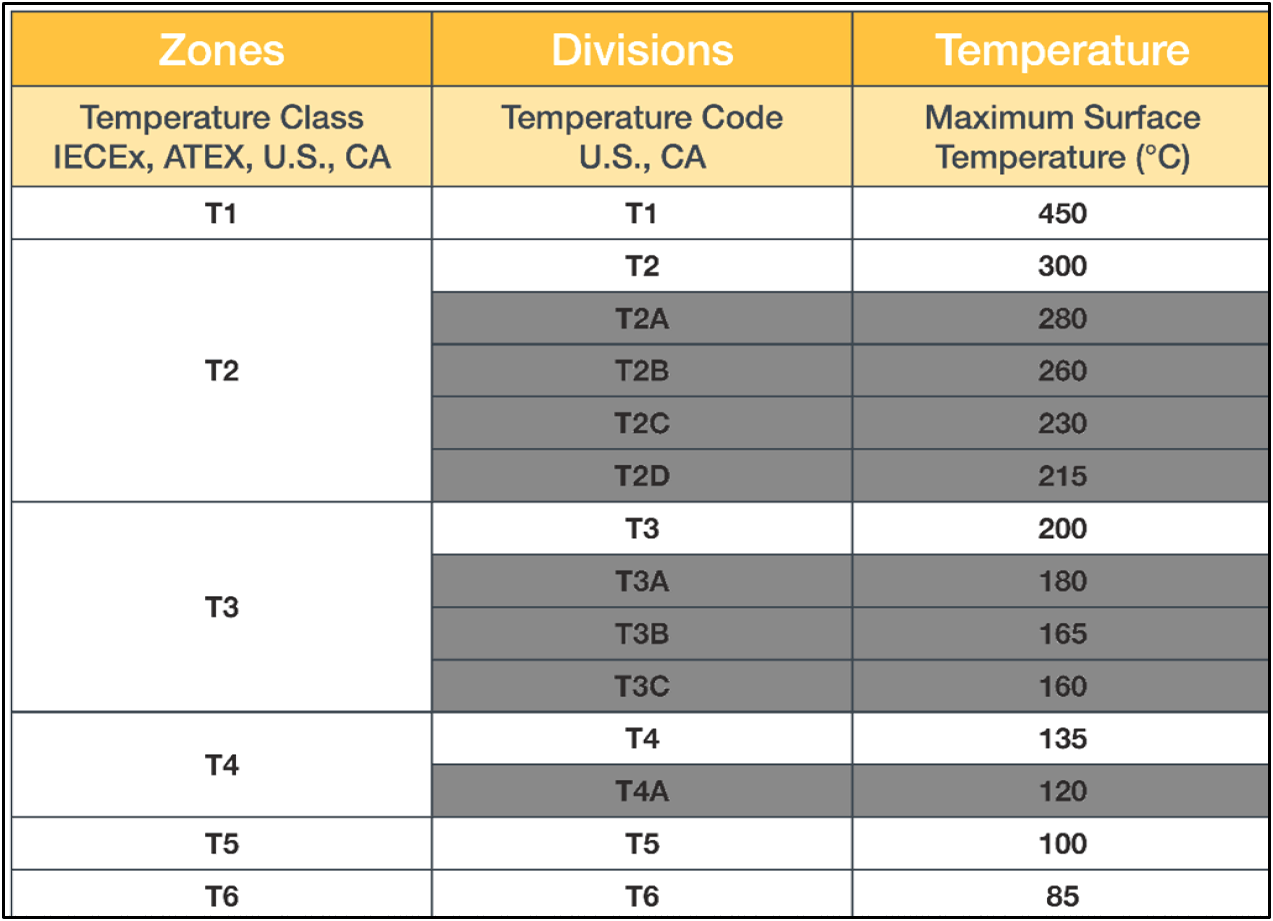
Figure 1 - Temperature Class
Equipment Under Test (EUT) is at a Testing Station and will be Temperature
Rise Tested,
at whatever the current ambient temperature is. The EUT is not tested in a facility at any particularly desired ambient
temperature. The difference between the recorded ambient temperature Tamb local (using two separate channels, with their own
(e.g.) thermocouple), and the worst case ambient temperature is recorded (the lowest one).
Example 1: Group IIB Ex d Enclosure – Initial Testing of Design
- The Equipment Under Test (EUT) has a dummy load installed within it, and the enclosure is secured with its fasteners (bolts). The worst case specified power dissipation figure is used and the energising voltage is increased to 10% above the standard line voltage. This provides a factor of safety on the temperature rise measurements.
- Many thermocouples are applied to all surfaces and to the glass window of the enclosure. At least two thermocouples are used to monitor the ambient temperature of the testing area.
- When the temperature rise is being measured with all of the thermocouples, and the temperature change is than 2°C per hour, the final values of all channels being recorded are noted, and the testing is concluded.
- After the testing is completed, the worst case temperature of the enclosure exterior was measured on the top of the enclosure, at Tenc = 55°C.
- The least ambient temperature recorded was Tamb local = 25°C.
- The standard certification reference ambient temperature Tref is 40°C.
-
Therefore, in order to determine the temperature rise value for a 40°C reference ambient temperature, calculate as follows:
- Tdelta = Tenc -Tamb local = 55 – 25 = 30K. This is the enclosure temperature rise over the local ambient temperature, measured in Kelvins (K)
- To determine the enclosure temperature in a 40°C ambient temperature (often called the Reference Ambient Temperature, or Tref), simply add the value of Tdelta value to the Tref to determine what the worst case surface temperature of the equipment would be in the 40°C ambient, T surf max 40C:
T surf max 40C = Tdelta + Tref
= 30K + 40°C
= 70°C
Referring to Figure one, the appropriate Temperature Classification for a temperature rise of 30K in a 40°C = T surf max 40C = 70°C for a reference ambient temperature of 40°C is T6. For a T6 Temperature Classification, the worst case temperature from any surface must be less than 85°C.
Example 2 – Installation site maximum temperature is 50°C:
- Ensure that the maximum temperature at the site can rise to 50°C by checking the Bureau of Meteorology website for historical temperatures and supplement this data with local measurements on calibrated thermometers.
- As the equipment is certified for as being T6 but only in a 40°C ambient, the enclosure as it is, cannot be installed at the site, of if already installed, cannot be energised.
- The worst case temperature for a T6 classification is ≤ 85°C.
- Accepting for the moment that you cannot gain access to the original temperature rise value for the rated power dissipation, which only the testing station and the manufacturer usually have access to, use the conservative figure of 85°C which is the Temperature Classification limit for T6, and for which the equipment is certified.
- Trise estimate = T6 limiting temperature – the original certified ambient temperature of 40°C
- Worst case Trise estimate = 85 – 40 = 45K [Note: while this is greater than the actual tested temperature rise figure of 30K, it will yield a conservative (safe) result]. When the estimated surface temperature is calculated using the site ambient temperature.
-
The new maximum temperature rise for a maximum ambient temperature of 50°C is determined:
- Add the new maximum ambient temperature (the site temperature) to the Trise estimate value of from (vi) above (= 45K)
- The new maximum surface temperature is therefore 95°C.
- The originally certified T6 (≤ 85°C) has been exceeded in this higher ambient temperature.
- The next Temperature Classification which will accommodate a 95°C surface temperature is T5.
- The equipment will need another label stating that the Temperature. Classification is now T5 when operating in a 50°C ambient temperature.
- Check that the cabling has a sufficiently high temperature rating to allow for operation at 95°C.
- All calculations and the resulting report stating that the temperature classification has now changed to T5 are to be stored within the verification dossier.
This material is produced by HAZ. The information is of a general nature only and should not be relied upon. Each set of
circumstances associated with compliance of hazardous
areas and Type
B compliance
is unique and expert advice on your particular circumstances should be sought. HAZ accepts no liability for any reliance on the
information published on this website.