Introduction
Any hazardous areas audit, is a systematic and critical examination of the installation, equipment, its operation and safety systems.
To say a piece of equipment is compliant is to say that:
- The installation has been correctly classified
- The equipment selection is correct
- The equipment has been installed as per the certificate of conformity and/or manufactures specifications
- Accessories and terminations comply, have been done correctly and, where relevant to a correct torque
- Equipment has been electrically tested and deemed safe
- The inspector is trained, competent and authorised
Currently there are two states (Queensland & Victoria) in Australia which the state government requires electrical installations in hazardous areas to be inspected/audited.
In Queensland the Electrical Safety Regulations 2013, Section 221 requires that an accredited auditor inspects electrical installations in hazardous areas prior to connection or reconnection to a source of electricity if:
- The installation is being connected for the first time
- Electrical installation work has been performed on an electrical installation within a hazardous area
In Victoria the state government regulations requires hazardous area installations be inspected by a Class H Licensed Electrical Inspector.
Although not legislated in other states, it is still good practice to have the installation audited. This is not done to delay completion but to allow another set of qualified and experienced eyes to ensure the finer details have not been overlooked. These overlooked details can be common when the personnel completing the project construction/ installation are also responsible for the compliance audit process.
Another problem that can arise is when the person(s) in charge of the area do not understand the risks, or their obligations when it comes to hazardous areas. In these instances when auditors do get called in to audit the installation they are usually faced with a barrage of questions and can be seen to be holding up the process. This is usually because they feel they (the person(s) in charge) have had competent people design, install and commission their equipment, unfortunately this is not always the case.
Additionally, the installers and engineers are apprehensive and sometimes defensive when details are found that should have been picked up well before the final Audit. But this shouldn’t surprise us when the volume of learning for the hazardous areas course is ~780hrs and it is delivered in five days across Coal, Dust & Gas, which suggests we are not getting the basics right.
Keep It Simple
Auditing is the process involving systematic examination of a system. Developing this process and following it is critical to ensuring the plant and equipment is compliant, safe and no details are missed.
To simplify a complex process, the following solution has been developed to audit hazardous areas and if followed gives the Auditor confidence that all details have been confirmed.
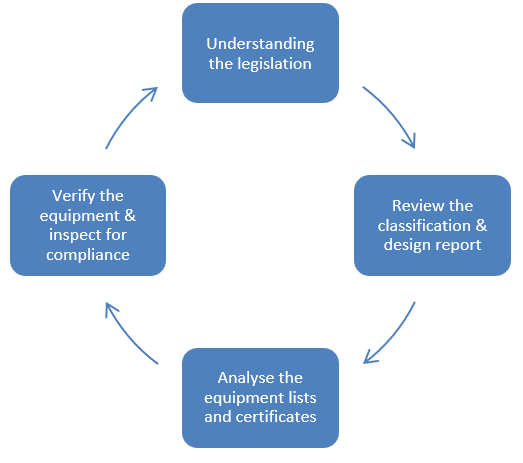
Legislations & Standards
The legislations that are imposed by the state and federal governments is what drives us to do what we do.
For hazardous areas, the relevant Acts and Regulations fit very definitely into two areas:
- Underground coal mining and
- Other industries.
For both areas the Occupational Health and Safety Act of the various states may be the overarching legislation.
Additionally, each Act may have a set of associated Regulations and provisions for these Regulations are generally made in the Act.
Regulations are generally drawn up by the department administering the Act.
In Queensland the purpose of the Electrical Safety Act 2002 is:
Division 2 Purpose of Act
4 Purpose
(1) This Act is directed at eliminating the human cost to individuals, families and the community of death, injury and destruction that can be caused by electricity.
(2) Accordingly, the purpose of this Act is to establish a legislative framework for—
(a) preventing persons from being killed or injured by electricity; and
(b) preventing property from being destroyed or damaged by electricity.
The Act calls the Electrical Safety Regulations 2013 where the purpose of the regulations is to ensure that the equipment is electrically safe. But depending on the industry (Petroleum & Gas, Mining etc) they all have their own legislations to which they need to comply. The responsibility may be spelt out in the Act, or in associated Regulation, or in a document called up by the Act or Regulations.
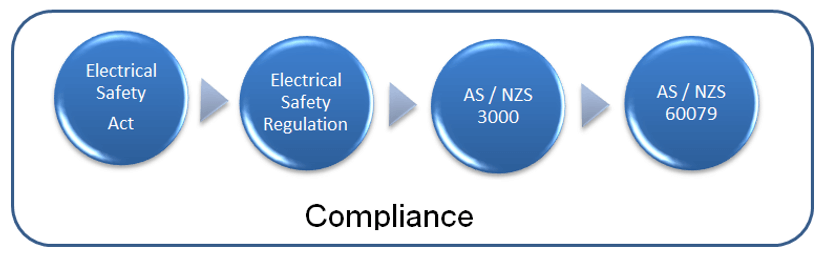
AS/NZS 3000 wiring rules is called up in legislation or contractually in each State/Territory of Australia and its requirements are therefore mandatory. From the wiring rules Section 7.7 specifically deals with hazardous areas where Section 7.7.2.1 Responsibility for classification states:
The responsibility for classification of a hazardous area rests with the persons or parties in control of the installation. The requirements are contained in AS/NZS 60079.10.1 for gas or vapour and AS/NZS 60079.10.2 for combustible dust.
So if you have been asked to Audit an installation, before rushing out there and getting your hands on the equipment ,ensure:
- The equipment owner actually requires an audit to be performed
- The equipment owner understands their responsibilities and obligations
Don’t be fooled though that the legislation will change the outcomes of the audit, it won’t as the physics and chemistry behind explosive atmospheres do not change.
Review Area Classification
The classification provides a concise description of the hazardous material that may be present and the probability that an unsafe event could occur. This is to allow an appropriate equipment selection so that safe installation practices may be followed.
Understanding what has been classified and why, gives the Auditor a firm basis upon to start the Audit. Knowing this critical information flows into the protection method and installation techniques that need to be adopted.
As an Audit relies on the facts, don’t just take people’s opinions or words.
An example; during a recent audit it was found the person responsible for hazardous areas had been providing the incorrect information on the classification of the plant which was that it was IIIB Non-Conductive dust.
Although in their Simtars report the classification stated
“In the view of this information it is difficult to classify coal dust, covered by this report, as being non-conductive without further information. In view of the possible variation in moisture content of samples, testing to the current standard 61241.1.1 for coal dust may not be conclusive”
Apart from being the incorrect dust group if the engineer had been providing this information to other hazardous areas installers and they had not challenged it, then potentially the equipment they had installed is non-compliant.
In addition to this it is important for the person classifying the equipment to have an understanding of how the system works in normal operation. A physical sample collector was found to have classification as Zone 22, which is based on this being a Secondary source of release.
By definition a secondary source of release is not expected to release in normal operation and if it releases is likely to do so only infrequently and for short periods. Now in normal operation this sampler would operate, therefore the classification appears to be incorrect, along with the fact the electric motor is in a defined hazardous zone and doesn’t have the appropriate markings.
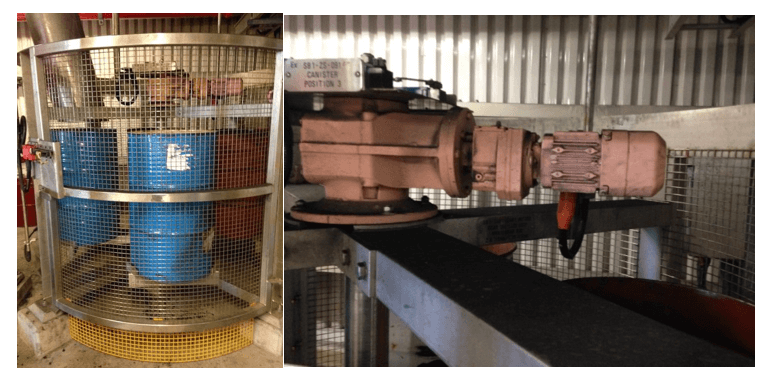
Another recent example.
As more coal seam gas and landfill gas sites come on line there has been an increasing interest in Type B appliances. For those who don’t
know what a Type B appliance is it Type B Appliance is a gas device that use >10mj/hr of fuel gas and isn’t covered by a
certification scheme. To a Type B specialist who holds a Gas Work Authority they will say because the system is gas tight and complies to
the gas codes; AS/NZS 5601 / AS 3814 and AS 1375 then it is compliant. However, a hazardous areas specialist will say it must comply with
AS/NZS 60079 series. Understanding the differences and where they crossover is important not only from a safety and cost perspective but
also for a successful and compliant audit. 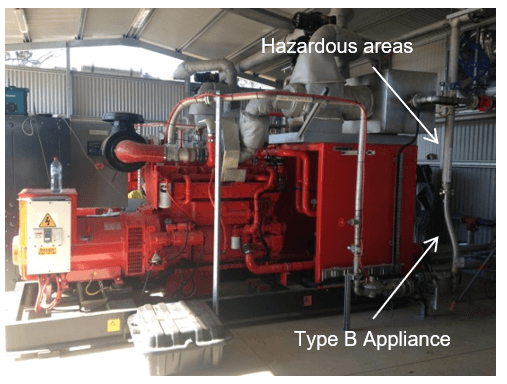
Having correct designs and classifications is a legal requirement, poorly designed hazardous areas installations with incorrect terminology can lead to potential safety, operational and cost issues.
Equipment and Certification
The equipment selected for hazardous areas should have the correct marking to satisfy the classification report. The equipment has been
designed with a safety factor to minimise the risk of it being a potential source of ignition. Accompanying the equipment will be a
Certificate of Conformity (CoC) from a relevant certifying body.
In Australia the equipment selected needs to have acceptable certification. In
AS/NZS 60079.14 Section 4.3.1 Equipment with certificates according to IEC standards or AS/NZS Standards states:
“Equipment certified under the IECEx Scheme and registered on the IECEx database
(www.iecex.com) or the ANZEx Scheme registered on the ANZEx database
(www.anzex.com.au) meets these criteria. Equipment certified under the AUSEx Scheme is acceptable when manufactured
within the certificate validity period”
A CoC attests that a sample of the explosion proof product, described on the Certificate, has been
- Independently tested and found to comply with the Australian / International Standards listed in the Certificate
- Has initial and on-going quality surveillance of the manufacturer's quality system and manufacturing capability
- A description of the equipment certified
Now time and time again the only reason the certificate gets looked at is because it has an “X” in the certificate number, therefore
there could be conditions of certification. Just because it doesn’t have a ‘X’ doesn’t mean there is no conditions. The certificate
certifies that the equipment has been tested and although there may not be an “X” it could tell the installer further information relating
to how the equipment needs to be installed to ensure that the integrity of the protection technique is maintained.
What installers / inspectors don’t see are the finer details which include
- the applicant and additional manufacturing site which should be on the marking
- The standards to which the electrical apparatus was found to comply to
- The Test and Quality Assessment reports
- What the equipment is
A snippet of certificate IECEx SIM 09.0001X is shown below. Listed in the appendix is a range of certified terminals.

Now if the installer didn’t look at the certificate they will never know that for the certified terminal under IECEx SIR 05.0035U there are
specific torque setting which used and unused terminals SHALL be tightened to.

Additionally, anomalies on the marking and certificate can be found which need to be addressed and feed back to the relevant certifying
body, for example
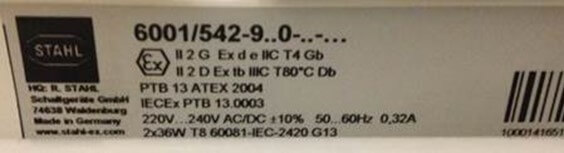
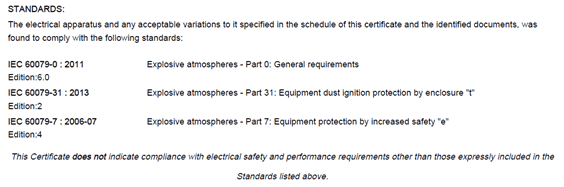
The markings on the equipment states “Ex d e IIC T4 Gb”. Cross referencing this to the certificate (IECEx PTB 13.0003) does show that the
marking are Ex d but there is no mention of “IEC 60079-1 Explosion atmospheres – Part 1: Equipment protection by flameproof enclosure ‘d’”
under the standards the equipment was tested to.
 This
level of detail is required otherwise how do you say the piece of equipment is compliant?
This
level of detail is required otherwise how do you say the piece of equipment is compliant?
Verify what’s installed
The first key to an hazardous areas installation is that the installer should have in their possession copies of the area classification,
installation standards, certification documents and other information relevant to the installation. It is obvious that the Audit is not
going to go well if the installer cannot produce these documents.
If the installers are qualified electricians then they have a responsibility to ensure that the electrical apparatus is electrically safe.
This means verifying the entire circuit supplying the equipment.
Every electrician knows that fuses are in the circuit to protect the cables and prevent them from overheating in a fault or overload
situation. In the next example the cables and equipment would have let the smoke out well before the fuse popped.
The circuit diagram below was from the vendor with recommended fuse sizes of 16A, these served two purposes:
- Protect the cable
- Protect the equipment.
As the installation was in a dust environment the fuses were there to protect the motor and cable from a rise in temperature sufficient to
ignite a dust cloud if it was to appear.
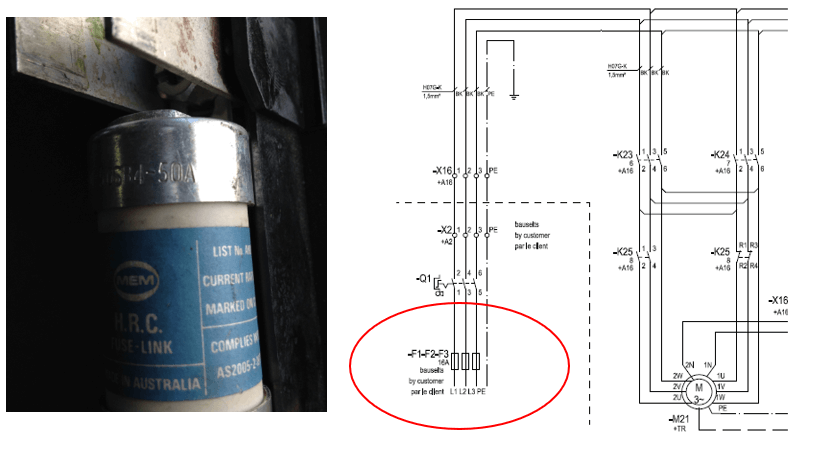
It was verified that the installed fuses were 50A HRC fuses protecting 6mm2 3 core and earth.
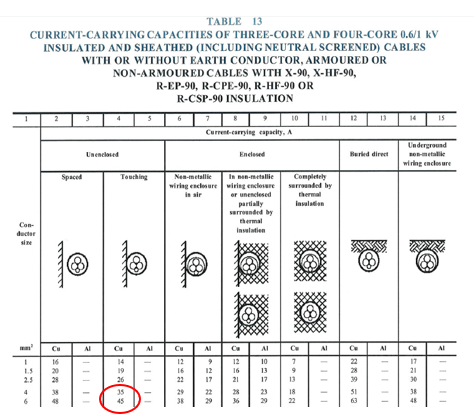
Just a quick diversion to AS/NZS 3008 – Electrical installation cable selection Table 13 shows that a 6mm2 is 45A, without a
derating factor.
Taking in to consideration that it was bunched with 10 other circuits from Table 22 the derating factor was found to be 0.48.
So the current carry capacity of the circuit was 21A.
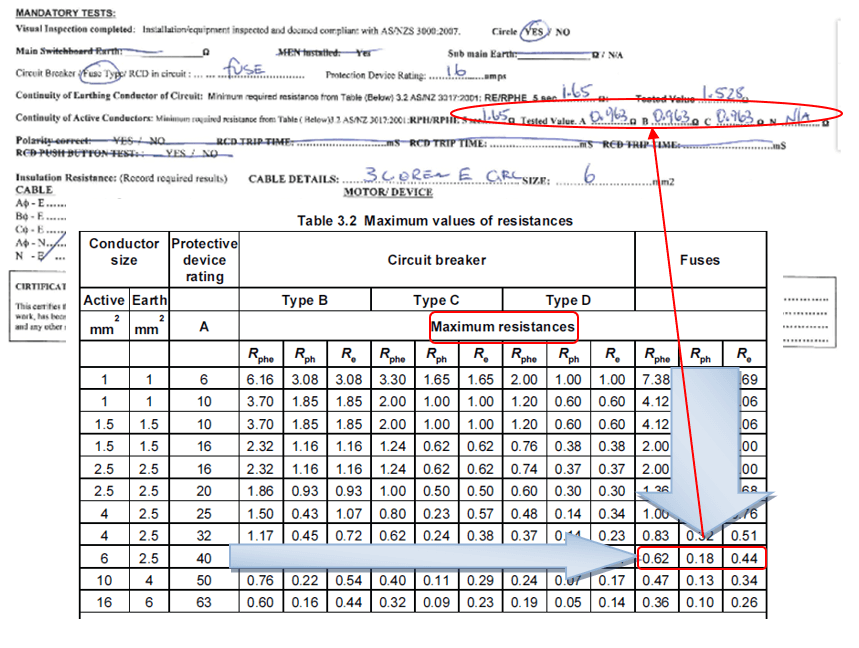
Test sheets are a legal document and the attention to detail is not given when taking the readings and filling them in. As electricians we
are required by the legislation to make sure electrical equipment is safe, in the test sheet below the electrician is putting himself and
others at risk by not understanding the results they are recording. There is no point in just writing down numbers if you don’t know what
they mean.
|
A simple check of AS / NZS 3017 Table 3.2 which has been stated on the electrical test sheet show that the values appear to be outside of
the MAXIMUM RESISTANCE for RE/RPH.
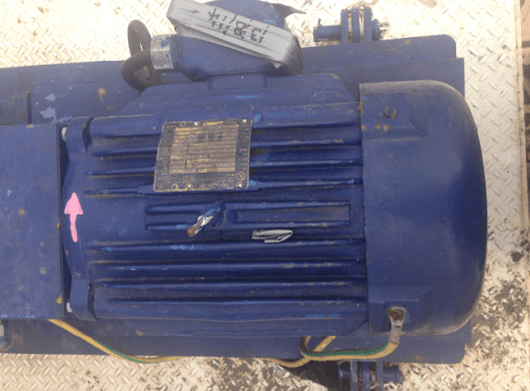
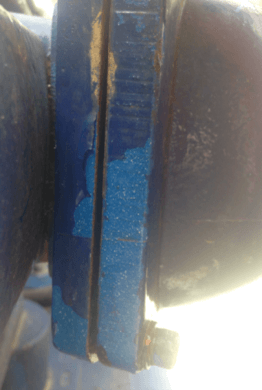
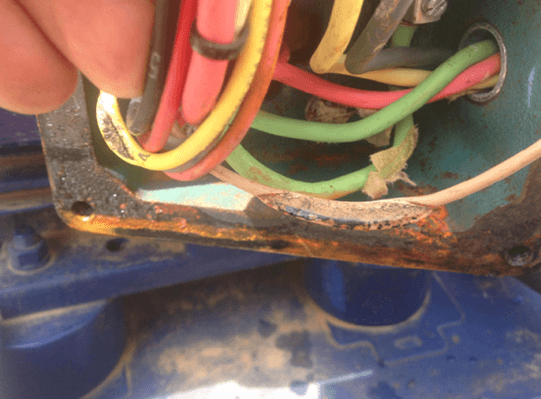
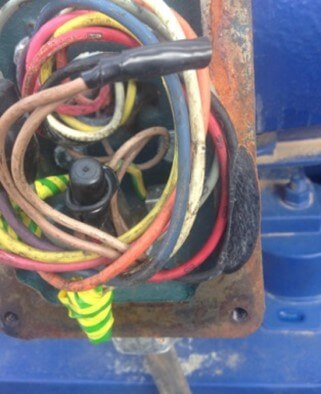
Poor workmanship plays a large part in why equipment is found to be non-compliant usually due to the installation, glanding and
terminations. Not only does this reflect poorly on the installer but these simple problems do not comply with AS/NZS 3000.
|
|
|
|
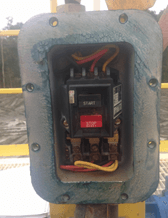
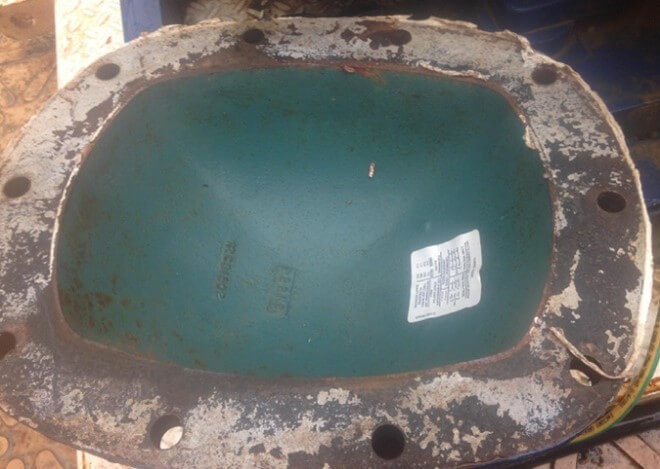
When equipment is installed in damp or wet areas the concern is water ingress into the equipment. The installer cannot take it upon
themselves to compromise flamepaths. In AS/NZS 60079.14 Section 10.3 Protection of flameproof joints, both concerns have options provided
which need to be followed.
 |
 |
In some cases there are times when equipment is installed in hard to reach places. In this example the junction box was located on a beam
without any access. The auditor felt comfortable enough to sign off the equipment without verifying what’s installed and simply compared it
to a spare junction box making the following comments.
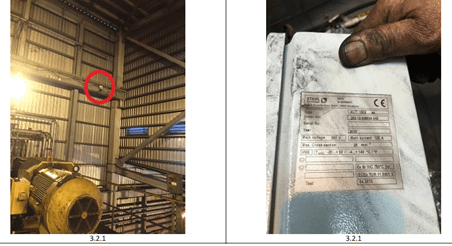
After scaffolding was erected it was found that the factory glands were loose and the equipotential bond was missing.
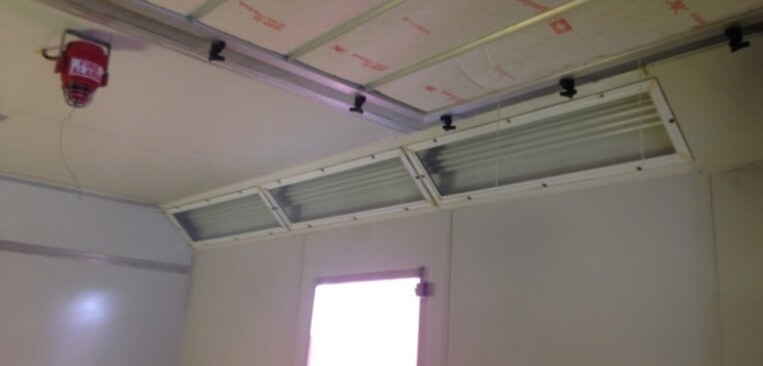
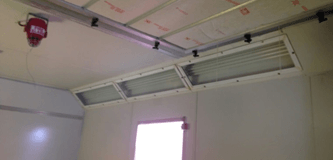
Another example where verification was important was a spray booth which has been in use for the past eight years. The owner was under the
impression it was compliant as all the paper work was available. But, the auditor identified a limitation in their final signoff of “booth
construction was not complete”
The findings after the verification was completed was that the lights do not comply with the state standards AS/NZS 4114 Part 1 & 2 nor
to AS/NZS 60079, and probably haven’t since the vendors original design.
The role of an Accredited Hazardous Areas Auditor
As previously mentioned, in Queensland a person must not connect or reconnect an electrical installation located in a Hazardous Area, to a
source of electricity after electrical installation work has been performed on the electrical installation unless—
(a) the electrical work has been inspected by an
accredited auditor; and
(b) the accredited auditor has confirmed that the
electrical installation, to the extent it is affected by the electrical work,
has been tested to ensure it is electrically safe
and complies with the requirements of the wiring rules and any other standard applying under
this regulation to the electrical installation.
This reference is from the Electrical Safety Regulation 2013 Section 221. You will notice there are key words which are bolded. People
(including Auditors) seem to think that we can wave a magic wand and the installation is compliant. Hopefully this paper demonstrates a few
examples of a very common issue to emphasise the importance of why we must INSPECT and CONFIRM
the installation before it is energised.
Conclusion
When it comes to hazardous areas auditing the devil is in the detail and the lack of detail is the risk. There are no shades of grey with
compliance, it is either compliant or it is not. Although the company / people want to be compliant after issues are found and presented,
there is no way around the requirements that need to be met. One of the biggest risks we see is when a company truly believes they are
compliant yet they are clearly not after if the audit findings are presented.
The auditor cannot just wave his wand and magically make the installation compliant. They didn’t design, classify, select, install or
commission the equipment, yet they are the ones seen to be holding up the process. If anything the owners should be happy that the
non-compliant issues were found now, not when there has been an incident or accident.
More focus needs to be placed on getting back to the basics. Just because the equipment has a certificate of conformity doesn’t mean its
compliant after it’s been installed. So remember whether the issues are from installation, equipment or administrative everything needs to
be fed back through to the correct channels so that continuous improvement occurs, and always remember to follow up.
It is important that the people understand their limitations when working in hazardous areas, as when non-compliances are found and re-work
is required the project soon becomes very costly. There are some of us who have been fortunate enough to have been taken under the wing of
very experience industry mentors and as the industry moves forward its our responsibility to pay it forward to lift the standard, as the
standard we walk past is the standard we accept.
This material is produced by HAZ. The information is of a general nature only and should not be relied upon. Each set of
circumstances associated with compliance of hazardous
areas and Type
B compliance
is unique and expert advice on your particular circumstances should be sought. HAZ accepts no liability for any reliance on the
information published on this website.